Showing posts with label Love amp; Romance. Show all posts

Sunday, August 14, 2016

My Lady Jane » Book Review

My Lady Jane was a strongly hyped book written by three well-known YA authors. I believe it was also an Owlcrate book for the month of May. I was feeling a little apprehensive going into the book because while I was familiar with all three authors, I couldn't say that I particularly adored their previous works.

Cynthia Hand is the author of the Unearthly trilogy, Brodi Ashton is the author of the Everneath trilogy, and Jodie Meadows is the author of the Newsoul trilogy and The Orphan Queen series. I've read the first book of both the Unearthly and Everneath trilogies, but the love triangle didn't inspire me to continue. I read a brief sample of the first Newsoul book and chose to stop there.

Thankfully, My Lady Jane didn't suffer any of those issues.

Tudor England


For most of us, the historical setting will be very familiar. Who wasn't fascinated by King Henry the VIII's various marriages and break from the Catholic Pope? It was one of the few times my class perked up during our history lessons. Even though our focus is on Lady Jane (made obvious by the title), we are initially introduced to Edward. From then on, our perspectives switch between Jane and Edward.

Edward is a teen boy who doesn't focus too much on his kingdom. All of his work is done through his privy council and his advisors, including Lord Dudley. He enjoys the company of his half-sisters, Elizabeth and Mary, and his cousin, Jane. Even though Edward wonders what it would be like to marry Jane, he is convinced by his advisors to marry her off to a Gifford Dudley, and to allow Jane's male heirs to be Edward's successors should he not be able to provide his own heir.

Most of that seems to be historically accurate as far as I can surmise from my AP History class and brief research. Now comes the interesting part...

Magic?


In this version of history, magic exists. More precisely, shapeshifters exist. Naturally there are two factions. Those who are shapeshifters and those who are not. They do have precise terminology within the novel itself. But it has been a little while since I've read the book and I've already returned it to the library so I can't recall them offhand.

We learn that Edward's father could turn into a raging lion if he was displeased. Edward and Jane spent much of their time as children wishing and practicing to be a shapeshifter themselves. The addition of these fantastical elements does allow a historical fiction book to appeal to a wider range of readers. It also allowed certain tweaks to be made to our version of history.

Romance


I did mention that Edward had considered what it would be like to marry Jane. However, there is NO love triangle in this book which I was deeply appreciative of. Instead, we get to see the romance between Jane and her new husband Gifford develop. This is actually one of my favorite tropes in historical romance novels. For whatever reason, I do love to see a marriage of convenience or a marriage of hatred to turn into a marriage of true love and affection.

This romantic story did not disappoint. I adored Jane as a character. She was intelligent and smart, focused and driven. I enjoyed her sense of humor and nothing fazed her for too long. Her interactions with Gifford were sweet and I was really rooting for both of them throughout the novel.

We also get to see romances develop with other key characters as well, but I'm feeling a little too lazy at the moment to expound upon that further.

My Rating & Why


I did really like this book. Even though it is close to 500 pages, I could read it relatively quickly. My only complaint is that it felt too juvenile. I would say that it fell closer to the middle-grade end of the spectrum rather than the mature YA that I was expecting.

The romance is VERY PG. The plot is quite simple even for someone unfamiliar with the historical time period. While I enjoyed the sense of humor from the characters as well as the omniscient narrator, it didn't set the book apart for me in any way.


Tuesday, August 2, 2016

A Promise of Fire » Book Review

Ellen and I were both DYING to get our hands on an ARC copy of A Promise of Fire when we saw the slew of 4-5 star reviews from reputable bloggers. Unfortunately, we didn't feel the same kind of magic that they did. Ellen disliked it (to put it mildly) and she already wrote up a review (HERE) detailing her less-than-stellar opinion of the book.

Fortunately for me, I didn't despise it quite as much as she did. But I definitely agree with all the issues that Ellen brought up in her review.

Catalia


Our main character, Cat (as she likes to be called), is 23 years old. I didn't figure that out until I started writing this review! She talks like a petulant 15 year old. During her inner monologue, she frequently uses words like 'gah' and 'gag'. If I was playing a drinking game, I would be drunk in 3 chapters flat. Okay, okay. I'm a lightweight. BUT STILL.

"Thanks the Gods. Gag!
Sort of.
Except not at all.
Gah! I'm going insane!"

SHOOT ME.

The synopsis calls Cat smart-mouthed.

stop-i-am-going-to-peeI wouldn't say that the words coming out of her mouth are... 'smart'. It's mostly a constant stream of 'I hate you', 'get lost' and 'let me go'. Look, I love a witty character. I LIVE for banter and sexual tension. She talks for the sake of saying words and to antagonize others. I should pull out quotes, but gaaahhhhh I don't wanna! (See what I did there?)

One of my bookish pet peeves is when a character claims that she is secretive and guarded and yet can't seem to keep her mouth shut and spills her secrets anyway. This happened NUMEROUS times. For example, even when she clearly makes everyone around her promise to keep her secrets from Griffin's family, SHE IS THE FIRST ONE TO BLAB IT OUT. It took about 10 minutes into dinner for that to happen.

Uh huh. Guarded. Secretive. I see it. Of course the BIG secret needed to be kept because how else can we stretch it into a trilogy?

My other pet peeve is when self-sacrifice is taken to the extreme (*cough* Supernatural *cough*). Cat is supposed to be a strong, badass woman with amazing powers. And sure she makes use of some of them, BUT TO THE POINT OF DEATH. This happened not once, not twice, but a total of THREE times. She gets completely conked out and needs Griffin to take care of her. That seems to be the feminist response to the damsel in distress trope. We can't have the female be completely incompetent... so let's make her snarky and powerful, but still need a man to save her from the aftermath of it to keep the romance alive!

Why a 3 Star Rating?


For all my griping, I did enjoy the read. It was frustrating at times, and cringe-worthy at times, but I kept going and I was always interested to see what was going to happen next. Even though Kato & Flynn (the other members of Griffin's personal team) were practically identical characters, I ADORED the brother/sister relationship they had with Cat.

Even though I found the romance problematic and Griffin a little too high-handed, I was still invested. Until a certain plot detail cropped up. Then I totally lost it. [spoiler]Magical sexual healing??? WTF! Poseidon sent Cat a magical jizz man to heal her?![/spoiler] I managed to get through it though. Thank god for Ellen.

Even though I firmly believe that this book didn't have to be stretched into a trilogy, I am still willing to give the next 2 books a shot. Hopefully it gets better from here.

A Promise of Fire releases today. Happy reading everyone!

Wednesday, June 15, 2016

These Shallow Graves by Jennifer Donnelly » Book Review

I am in awe of how this book made me feel. Ellen believes that it doesn't compare to Donnelly's A Northern Light, so I'm very excited to pick that one up soon and see how These Shallow Graves will measure up against Donnelly's most critically-acclaimed work.

At first glance, I expected it to be a run-of-the-mill mystery with a throwaway romance. In fact, as I was reading, I had picked out a quote that I thought would impeccably sum up the cheesiness of the romance.

"He can only break my ribs, Jo, not my heart."


Nauseating... am I right??

But I was forced to eat my words. As I accompanied Jo on her various jaunts through the city and witnessed her life through her eyes, I realized how similar she and I are (or were). I mentioned briefly in my introduction post about living in a rural part of India during some of my teen years. I lived with my grandmother, mother, baby sister and our maid under strict lock-and-key. Young girls were not to be out and about unaccompanied, let alone be out past twilight. There were rules about proper behavior, who I was allowed and not allowed to socialize with. And by god, I was not to tarnish the family's reputation. Her struggles, were my struggles.

“Why is it, she wondered now, that boys get to do things and be things and girls only get to watch?”


I loved Jo, because she is a realistic character. Even the romance (which I initially scoffed at), and the love triangle (which as a rule, I utterly detest) didn't drive her story. It just happened to be her life. As a young heiress, she was expected to wed, and wed well. It is her love for her father, and her noble notion of justice that drives her story of personal growth. While she made romantic decisions that I thought were hasty or foolish, they remained true to who she is. And above all, there were realistic consequences for her decisions. Her poor choices and in turn, the reactions of the characters around her helped her evolve and understand herself better, and in turn, make better decisions for herself in the future.

“You, on the other hand, wish to know things. And no one can forgive a girl for that.”


“That was what people did when they wanted to stop a girl from doing something—they shamed her.”


I also was very pleased with Nellie Bly as an inspirational figure to Jo. Nellie Bly is a reporter that Jo admires both for her accomplishments in a male-dominated field of journalism as well as her compassion for the 'invisible' people that pass through New York City. It hits me close to home because THIS is why it is so important to have women and minorities (of any kind, whether it is race or gender or sexual orientation) have such important roles in society. They inspire current and future generations to follow their path and further their path. Nellie Bly is the reason that Jo developed her strong sense of ethics, which I greatly admired.

“Headstrong is just a word, Katie - a word others call you when you don't do what they want.”


I'm sure some of you are curious about why I am gushing so much about this book since I didn't give it a full 5 or even 4.5 stars. That had to do with the mystery element and the pacing of it. Perhaps I have simply watched too many crime shows and read too many books and hence can spot a red herring a mile away. I figured out who the villain was within the first third of the book. I had guessed everything, except for one important surprise. However, I still enjoyed Jo's and Eddie's adventures mainly because they took me all around New York and it was fascinating to be there. My favorite scene occurred when Jo was walking along a bridge (maybe the Brooklyn bridge..?) with a friend, and I could just picture how exhilarating that must have been. I think that's the wonderful thing about historical fiction for me, when compared to fantasy. It's easier for me to picture and imagine that this actually happened. The next time I go to New York, I will walk alongside a bridge and smile to myself as I picture Fay and Jo Montfort.

“We who have means and a voice must use them to help those who have neither. Yet how can we help them if we don't even know about them? And how can we know about them if no one writes about them? Is it so wrong to want to know things?”

Sunday, December 6, 2015

Daughter of Smoke and Bone » Review

This book, written by one of my favorite authors, did not make a great impression the first time around.  Although you don't know it at first, this first book in Laini Taylor's Daughter of Smoke and Bone trilogy [spoiler]truly starts in medias res.[/spoiler] There is a lot going on, as well, and it's difficult to get a grip on during the first read-through.  The first time I read the book, I made a lot of incorrect assumptions, like [spoiler]that we were dealing with insta-love. We're not.[/spoiler] I also disliked our main character, Karou, thinking she was a tiresome, self-impressed hipster chick, which she kind of was (in the first book), but when you know all of her backstory, Karou becomes immeasurably more likable. Unfortunately, it takes a while for that backstory to come into play.

What made me push through Daughter of Smoke and Bone was the wealth of positive reviews for the book and my enjoyment of Taylor's short story collection, Lips Touch: Three Times.  I decided I wasn't giving the series the good ol' college try and made another attempt.

I am so glad I did.  Because, while I'm hesitant to call the Daughter of Smoke and Bone trilogy something like a 'masterpiece,' it is most definitely an 'achievement.'  Laini Taylor's imagination is just insane.  It's a pleasure to dive into and swim through.  She writes well, treating us to surprising little similes and turns of phrase that are so rarely found in YA these days.

About Laini Taylor's style — it's very distinct.  It's distinct to the point where if I read a piece of hers without her name attributed, I'm very certain I could identify it. That's really remarkable, when you think about it. (Remarkable on Taylor's part, not mine :P) So many authors struggle with finding a distinct voice, and Laini Taylor just nails it. Really, the only author I can think of that Taylor shares similarities with is Holly Black, and even then, there are strong differences between the two.

Taylor's style mixes dreamy elements of fantasy with modern settings — romance and humor sprinkled throughout.  There are, of course, Taylor's signature similes and unusual turns of phrase aplenty, although these are much thicker in her short stories than in her novels.  And then, there is always a dark undercurrent of aggression, greed, and sexual violence. I'll get to those issues more in my review of Days of Blood and Starlight, but for now I'll just say that Taylor most definitely has a strong thematic message throughout her body of work.

Anyways, about the actual book.  It opens with a blue haired girl, Karou, being attacked by a vampire.  When I first read the book I was all, "NO! Not another vampire book!" But it's a false alarm — Karou's ex-boyfriend is a street performer/tour guide who dresses like a vampire. Karou, her faux-vampire ex-boyfriend, and her close friend, Zusana, all live in Prague — a nicely exotic setting.  Karou and Zusana are art students and I'd now write that Karou lives a pretty normal life... only she doesn't.  She is replete with mystery.  She knows martial arts, keeps a knife in her boot, speaks tons of languages, never seems to dye her perfectly blue hair, and good luck follows her everywhere.

We find out the answers to all of these mysteries soon enough, but I found it overwhelming to take in at first.  Laini Taylor has created an immense story and it's a lot to take in.  This is unquestionably my main complaint with the book, but I couldn't tell you how to fix it.  I'm not sure that Taylor didn't do the best job possible easing us into her huge concept.  It was confusing as all hell at first.

Another weakness of the story lies in the *first read-through* of the romance.  When reading the romance for the first time, there are so many misconceptions because the backstory is just not there.  [spoiler]You don't even know that there IS a backstory.[/spoiler] So, when I first read the book, I thought, this is intolerable!  It isn't, actually — it's just way more palatable and intriguing once you know more about what's going on in the story.

Overall, Daughter of Smoke and Bone is a very good beginning to a great series.  There are definitely some issues with how the immensity of information is introduced, but don't ask me how Taylor could have done better.  I give this first book in the trilogy four stars.

fantasy CREATIVE refreshing UNIQUE


Thursday, October 29, 2015

My True Love Gave to Me » Review

I'm on an anthology roll, finishing up the horror collection, Slasher Girls and Monster Boys, and heading into the decidedly more romantic My True Love Gave to Me.  Whenever I was in bookstores last winter, this book was being clutched and cooed over, and I believe it did very well for itself.  Is there any way we can check book profits, like a boxofficemojo.com type site for books? Anyway, Stephanie Perkins, a big, big name in YA publishing, serves as the editor for this collection of romantic, holiday stories.  Let's jump in!

Midnights » Rainbow Rowell » 4 stars


"It was cold out on the patio, under the deck."


The anthology doesn't pull any punches, starting out with the master of "aww,"  Rainbow Rowell.  Rowell doesn't disappoint fans of straight-forward romance with Midnights.  She delivers a cute will-they-won't-they that hops across the years.  Depending on your taste, this story will be a winner or even a little limp, however. There is no edge to this story — it's as blunt as the edges of a sugar cookie, and just as sweet.

The Lady and the Fox » Kelly Link » 3 stars


"Someone is in the garden."


Kelly Link writes a modern day fairy tale, as suggested by the story's fable-ish title.  Miranda's mother is in prison, so she spends every Christmas as part of the crowd at her godmother's Downton Abbey-esque, family estate.  There are plenty of nooks and crannies to explore and a garden that holds a magical captive.  If anything, this story was a tad unfocused, hopping between Miranda's growth into adulthood and a somewhat unfeasible romance.

Angels In the Snow » Matt de la Peña » 4.5 stars


"I didn't tell anyone how dire shit had become."


I was surprised when I enjoyed this story so much, because I've never heard of Matt de la Peña.  This just goes to show that gems lie in wait in anthologies, despite the name recognition factor of the authors.  This story follows Shy, a Mexican-American college freshman at NYU, who's cat sitting during his Christmas break, but can't afford to feed himself.  He's slowly starving when the girl in the apartment upstairs comes to the rescue.  It's a great story.  My only complaint is the ending hits a bit of a bland note, when the beginning and body of the work were full of life.

Polaris Is Where You'll Find Me » Jenny Han » 2 stars


"Elves."


Polaris was, unfortunately, my least favorite story in the anthology.  Told from the perspective of Santa's adopted daughter, readers must endure a vapid, boy-crazy narrator and her substance-less quest for adolescent like.  A definite low-point for the collection.

It's a Yuletide Miracle, Charlie Brown » Stephanie Perkins » 3 stars


"Marigold loved this Christmas tree lot."


I expected quite a bit more from Perkins, one of the queens of contemporary YA, but Yuletide Miracle wasn't a bad installment.  Our two characters meet, spontaneously hang out, exchange a lot of dialogue, and get together all in the space of a few hours.  Maybe it goes to show how effortless Perkins' writing is, but this story felt like it was whipped out quickly.  Maybe that's not the case at all, but I didn't get that slavishly crafted feel that other stories in this anthology gave off.

Your Temporary Santa » David Levithan » 4 stars


"It's hard not to feel just a little bit fat when your boyfriend asks you to be Santa Claus."


With a killer first line, Levithan delivers the laughs in his short story, which, of course, features our only gay couple.  Our narrator is freaking hilarious in his earnest attempts to make his new boyfriend's little sister believe in Santa.  My only complaint is that Connor, the boyfriend, has reduced pagetime to make way for the enormous, nervous introspection of our main character, who is never named.

Krampuslauf » Holly Black » 4.5 stars


"Fairmont's second annual Krampuslauf felt a little bit like a parade and a lot like a zombie crawl, except instead of the undead, we were dressed up like Saint Nick's creepy buddy, the Krampus."


I expected Holly Black's installment to be a little weird, and she didn't let me down.  Her story reminded me quite a bit of The Coldest Girl in Coldtown, with supernaturals crashing a teenage rager.  Although, I don't know whether to give points or take away points for the weirdest line in the entire anthology, which details our protagonist's dream about being erotically flayed by Satan. Yeah, you read that right.

What the Hell Have You Done, Sophie Roth? ’ Gayle Forman » 2.5 stars


"In the fifteen weeks since starting her freshman year at the University of Bumfuckville, Sophie had counted at least a dozen What the Hell Have You Done, Sophie Roth? moments."


Forman, another queen of contemporary YA, makes a bit of a misstep with Sophie Roth.  There's a decidedly negative tone in the story.  I understand that our main character has a cranky personality, but it brought the holiday cheer factor down quite a bit.

Beer Buckets and Baby Jesus » Myra Mcentire » 2 stars


"The whole mess started when I lit the church on fire."


Mcentire's story started out strong, reminding me distinctly of my childhood favorite, The Best Christmas Pageant Ever.  Unfortunately, the dialogue become somewhat stilted and preachy as the minister and minister's daughter deliver speech after speech to the overly receptive town troublemaker.

Welcome to Christmas, CA » Kiersten White » 3 stars


"If you do a search for "US cities named Christmas" (which, get a life, weirdo), you'll get five main results.


White's main character, Maria, is just as crabby as Forman's S0phie Roth, but is counterbalanced by a love interest who practically embodies the spirit of Christmas.  What this story does very well is show how a gloomy situation can turn around when viewed from a different perspective.

Star of  Bethlehem » Ally Carter » 2.5 stars


"As Christmas stories go, this one isn't as sad as it could be."


This story started out with a great hook — two girls switching their plane tickets — but the Disney Channel ending was out of control.  I like stories with a bit more grit to them.

The Girl Who Woke the Dreamer » Laini Taylor » 5 stars


"It is the custom on the Isle of Feathers for young men to leave small gifts for their sweethearts on each of the twenty-four days of Advent."


How totally excellent that the anthology ends on its high note.  Laini Taylor's imagination continues to bust its seams in a story that indirectly touches the holiday theme.  In Taylor's fictitious island, a fire-and-brimstone Christianity has replaced polytheistic, pagan beliefs.  Neve, an impoverished young woman, finds herself in dire straits when targeted as a prospective wife by the island's nasty, evil preacher.  She prays to the island's old gods and receives an unexpected answer. There were so many lines that I loved, in this lyrical, sexy tale, that funnily enough, kind of shits upon traditional Christian Christmas.

Overall, not as strong an anthology as Slasher Girls, but still solidly enjoyable.  Because I'm continuing on my anthology streak, I'll be reading Geektastic next, edited by mah gurl, Holly Black. Tune in next time.

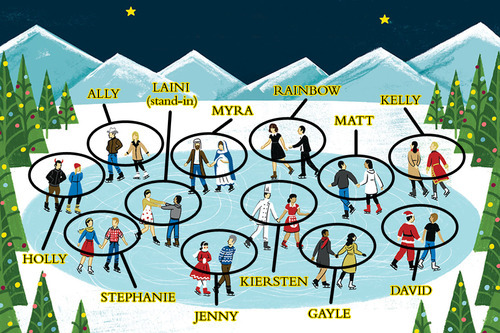
[caption id="" align="aligncenter" width="500"] I was trying really hard to match the skaters on the covers with the romantic pairings in each story, but damn if Laini Taylor's god, Wisha, didn't mess up the uniformity of the figures. Credit goes to another source » click on pic to go to there.[/caption]

Sunday, October 25, 2015

Carry On » Review

Carry On is a strange novel, with a strange, nesting doll-like genesis.  First, there was a little series called Harry Potter and Rainbow Rowell, a writer, wrote Harry Potter fanfiction online.  Then Rowell published an original novel called Fangirl, where a character, Cath, writes fanfiction about a series called Simon Snow, which Rowell bases off of Harry Potter.  Now, Rainbow Rowell has published the book that Cath the character was writing as fanfiction — and both are titled Carry On. Got that?

Carry On is tied so closely to Harry Potter, it can come across as a spoof at times.  There are jokes that I think poke fun at Rowling's masterpiece a little, such as Voldemort's propensity to attack Harry constantly at Hogwarts — purportedly the safest place for Harry to be.  In Carry On, the Mage, our Dumbledore-like character, tells Simon Snow that he must leave Watford School of Magicks immediately because the Insidious Humdrum just won't stop attacking Simon there.  I got a good laugh in at that.

But aside from the jokes, Carry On is mostly a loving homage to both Harry Potter and the the once thriving culture of Harry Potter fanfiction.  While reading Carry On, I felt enormous nostalgia both for Harry Potter and for one of my favorite pieces of fanfiction, The Shoebox Project.  

[caption id="" align="aligncenter" width="602"] The Shoebox Project's Moony, Wormtail, Padfoot, and Prongs.[/caption]


The Shoebox Project was a multimedia effort by two college students, one a writer and the other an artist, who shared the passionate belief of many that Rowling's characters, Remus Lupin and Sirius Black, were so, so gay for each other.  The Shoebox Project was highly sophisticated, hilarious, and moving.  I'm not entirely sure if Rowell is familiar with The Shoebox Project, but I kind of hope she is.  It so perfectly encapsulates what Carry On represents — the brainchild of a nascent writer, made with equal measures of talent and passion, that can never see the mainstream of literature, but is nonetheless followed by many thousands of fans.

Apart from its ties to Harry Potter, Carry On stands on its own feet as a powerful and well-written story.  For instance, Rowell writes characters that are clear translations of Rowling's famous characters, but nonetheless emerge as distinct and fully dimensional characters in their own right.  A great example is Penelope Bunce, our Hermione Granger character.  At the beginning of the story, I was only making comparisons between Penelope and Hermione.  As the story went on, however, I stopped comparing and contrasting entirely.  Penelope Bunce was her own, wonderful and clear-cut character.

As for the romance, it was hot without being explicit.  I loved Simon and Baz together — their intense love/hate obsession and their never knowing if they want to smack or smooch each other. There are not tons of mainstream YA books out there with gay romance, but I can see the tide turning soon. Carry On is a great example of how gay romance can bust out of its niche corner and be appreciated by all.

One thing I didn't like about Carry On was the pacing.  Our exposition was enormous. It took a long, long time for the gears to get turning.  And then, the plot ramped up to a fever pitch.  One revelation was coming after the other, the pages of the book were dwindling, and I just wanted to yell, stop, stop, STOP! Slow down! Instead of a proper triangle, the plot looked like a blip on a heart monitor.

Then there were some inconsistencies with the language.  Rowell did a good job at incorporating British slang, especially in a manner than reads like American fanfiction — jumpers, trackies, boaters, etc. What better example than this quote...
"Agatha, is everything, you know, tickety-boo with Simon?"

There were some places though, where the continuity of language lapsed. Baz being described as "smart" instead of "clever" was a glaring oops.  And then, in the beginning portion of the book, we see "magic" be spelled "magick."  However, later in the book, we revert to the popularized spelling.
"Thank magic! I was worried you'd never speak again."

This isn't a big deal, just something I noticed. Overall, I loved Carry On.  I can't recommend it enough for both fans of J. K. Rowling (which is pretty much everyone) and for fans of Rainbow Rowell.

Bravo, Rowell. Carry on writing, and I will carry on reading.

fangtastic FED-THE-NERD magical MALE


Saturday, October 24, 2015

First & Then » Review

This was a quick, sweet contemporary read, but it was not without major flaws that keep it from being a standout.

First & Then follows Devon, a young lady entering her senior year of high school.  She has no idea what she wants to do, and feels like nothing about her is special.  In this way, she reminded me quite a bit of Isla from Stephanie Perkins's Isla and the Happily Ever After.  Only more depressing.

Devon was a bit of a frustrating bore at first, always complaining, snarking, and rolling her eyes over pretty much everything.  Worst of all was her initial hostility and disdain for her younger cousin, Foster, who is staying with Devon's family due to the death and drug abuse going on in his own family unit.  Devon eventually comes around to her peculiar cousin, but too little too late, in my opinion. Why couldn't she love the little geek from the get-go?

The story gets rolling, not because of anything Devon does, but because of Foster's sudden prodigious talent for kicking footballs.  He's thrust into the spotlight and taken under the wing of All-American running back, Ezra Lynley.

Devon, who has always followed the football team with interest, gets more caught up with the team's business.  She hangs around their practices, games, and parties... that's pretty much the book.

There are a ton of arcs that had the potential for great drama, but Mills pulls back in every instance.  She shows us plenty of guns on the wall, but none of them ever fire.  I couldn't think of a more perfect example than the oddball teen, Marabelle, who is pregnant. The identity of Marabelle's baby daddy is hung over our heads, there is a romantic angle between her and Foster that is teased. We discover a surprising connection between Marabelle and another character... Then nothing. Marabelle drops off the map.  It's disconcerting, and it isn't the only character that Mills builds up and lets go.  Like Emir Zurivic, a weird Eastern European high schooler and mob-ish character. We meet him, see him periodically, and then his final scene comes and goes, and it's like... wait. Was that it?!

There are more things I could nitpick, but whatever.  Overall, despite the book being seriously flawed, I still read it in one go.  Despite the faults, Mills has a compelling voice that keeps you reading.

Saturday, August 1, 2015

The Madman's Daughter » Review

This book made me want to tear my hair out! I usually don't mind when what I read is bad or silly, but The Madman's Daughter had such promise! It made the novel's eventual failure so disappointing.

The story is of the gothic style, nodding the kind of romantic horror embodied by Mary Shelley's Frankenstein. I loved this homage, especially in the beginning, with Juliet Moreau, our protagonist, creeping about a medical academy after hours, cleaning up after surgeries. There's an early scene where she euthanizes a rabbit that some medical students were using for vivisection. She puts the animal out of its misery by chopping it's head of with a surgical axe. It's great stuff.

I also loved the early middle of the book, when Juliet tracks down her family's former servant and her childhood friend, Montgomery. He's been in hiding with her father, who fled England, almost a decade earlier, due to grotesque allegations. Juliet learns from Montgomery that her father is living and working on an sparsely-populated island off the coast of Australia. Juliet insists that Montgomery take her to her father. Montgomery, Juliet, and Balthazar, a peculiar assistant to Dr. Moreau, getting on a seedy ship and sail to Australia. On the voyage, the ship picks up a half-mad castaway, a gentlemanly man called Edward. Juliet takes a liking to him, and decides to take him under her wing.

However, once the party arrives at the island, the story unravels. What had been a tight plot unfurls into madness — not the compelling kind. The characters have the same confrontations over and over again. Juliet worries over the same issues a gazillion times. And then there was the love triangle. What can I tell you about that love triangle? It was exceedingly tiresome and immature, and made me lose all respect for every character involved and for the author. It wasn't just bad writing. It was pathetic writing.

I sound harsh. I realize this. But, the early part of the book was so very good. I'm just aghast at the turn the novel took for the worse.

I will read the sequel and the final book after that. I think it would be a pity not to. I am also holding onto the hope that Shepherd will turn this series around and live up to the kind of writing I know she's capable of.

Wednesday, July 29, 2015

Illuminae | Review

It's been a few weeks since I closed the cover on Illuminae and I'm rethinking my initial rating of four stars.  I might be a hardass and lower it.  As I've written this review, I've gotten crankier and crankier about certain aspects, although I do have to be fair — this book grabbed my attention from the get-go, and it wasn't until late in the book that I started critiquing its faults.  Let's get down to it.

The novel is narrated through documents and messages, a type of updated epistolary style.  At first I thought that this would cramp the pacing, and it did to an extent, but not nearly as much as I anticipated.  For having all of its action be related as past events, Kristoff and Kaufman did an amazing job at making the the narrative seem like the present.

Our novel starts off with a cover letter for a compilation of documents.  The letter tells its recipient that the documents will relate the story of a catastrophic event on an illegal mining colony (in outer space).  We start off with two teenage survivors of the catastrophe being interviewed (our protagonists).

Before the catastrophe, Kady was a spunky, punky young lady with aspirations of college and traveling the universe.  Ezra was a talented G-ball jock with a close bond with his miner dad.  The two kids used to date.  Except, they messily broke up hours before the catastrophe occurred.  They both made it off the colony, thanks to Kady's badassery, but are on separate rescue vessels. Most of the novel follows their independent activities on different ships.  Ezra is drafted into the military as a pilot.  Kady is taken under the wing of an accomplished computer hacker.

I don't want to get into the plot further, because of spoilers, but there is a lot going on in Illuminae.  There's a pursuit across space, a deadly contagion, malfunctioning artificial intelligence, an evil corporation, and more!  To be honest, it was too much at times. One or two plot points could have been excluded and the story would have been much more streamlined.

Another thing that could have been improved was the style of narration that took up most of the climax. [spoiler]That of AIDEN, the Artificial Intelligence.[/spoiler] In my opinion, it was the least dynamic narrative style, and made the finale of the book annoying to read.  It was like reading high school poetry. Blah. I can't emphasize enough how much I disliked [spoiler]AIDEN.[/spoiler]  Speaking of high school, I hated the texting abbreviations and :P faces that littered the book.  Just personal preference.

One MORE thing.  I couldn't help but notice the extreme similarities between Illuminae and Kaufman's Starbound collaboration with Megan Spooner.  In fact, they are ridiculously alike. Now, writing similar works isn't exactly a sin, but Kaufman is risking becoming a one-note author, which isn't exactly good.  It definitely made me wonder, though, what traces of Jay Kristoff were in Illuminae?  Did he serve to make the male lead more authentic?  Is he responsible for AIDEN? I'm curious, because it's hard to tell.

Now that I've sufficiently ragged on Illuminae, let me spend some time praising it.  The book was good.  Period.  There's a lot of bad YA out there and Illuminae floats to the top without breaking a sweat. I was sucked in the the story immediately and read the book in one sitting. I enjoyed myself.  That is not to say, however, that there's no room for improvement.  I think the novel could have benefited from adding dimension to EVIL Corps, or whatever it's name is, having the characters be fleshed out further, shaving off plot bulk, and more.

All in all, I can see Illuminae being a popular book, but I doubt it'll be a breakthrough hit.

Tuesday, July 28, 2015

The Midnight Thief | Review

The only reason this little fantasy novel came to my attention is because its sequel was on a list for August 2015 releases.  Thank Jesus that I don't have long to wait to read the second book, because I am officially a fan of the series.

The Midnight Thief features thieves and assassins in a fantasy setting — a dynamite combination.  Our thief is Kyra, a young lady who pays the rent by taking on burgling jobs.  She's has a bit of a Robin Hood mentality, however.  She only steals from the citizens of her city, Forge, who can afford it.  Trouble starts, however, when Kyra's impressive talents catch the attention of James, the young and ruthless leader of Forge's assassin's guild.

Now think.  This is a YA fantasy.  Kyra is a young woman.  James is a young man.  All reason and genre precedents lead to there being a romance between the two.  And it sort of happens.  Sort of.  But more than that, there is incredible tension between the two.  I was staggered by what went down between these characters.  I can't say anything more, except that I am extremely interested to see where Blackburne is going to take the relationship between the two going forward.

Somewhat less interesting is our second narrator, Tristam, who is a soldier for Forge.  He has been stationed out beyond the city walls, attempting to protect the suburbs, if you will, from raiding parties of humanoid monsters that ride gigantic cats.  Yes, you read that right.  It's a little weird, but I can forgive the oddity.  Through Tristam, we get the perspective of the side of the political opposition to the assassin's guild and James.  Unfortunately, or perhaps not (???), there may be a love triangle a-brewing amongst Kyra, James, and Tristam.  All I can say is, if Blackburne decides to develop that gist, then I have no idea how things will unfold.  I have a favorite, isallI'msayin'.

I'm almost ashamed to admit... but I'm solidly Team James.  I KNOW! He's so violent and, if not evil, then certainly bad.  He does bad, bad things in The Midnight Thief and I would understand if his status as a love interest is completely compromised.  I can't help, however, but hold out hope for his redemption.  He's an enthralling character.  As Kyra notes:
There was something about James—his intensity of purpose and strength of personality—that could inspire a woman’s loyalty despite the cost.

I'm a fan. Going forward, I hope that James does not become the story's villain outright.  He is given nice dimension in The Midnight Thief, but the ending sees ol' Jimmy on very uncertain grounds.  Basically, I'm dying to see what happens next.

As for complaints, I will say that the pace at the beginning may have been too breakneck.  It was nice to have matters develop so quickly, but it also seemed a little slapdash, having scenes tie up so fast.  Likewise, it might have been nice to have some more world-building happen in beginning so we get a better idea of the setting our characters are operating in.  Overall, it's not bad when your main complaint is wanting moar!

Naturally, I will be reading book two, Daughter of Dusk, the day it comes out.  Stay tuned for my reaction to the second installment in this promising, new series!


Thursday, July 2, 2015

Daughter of Deep Silence Review

Remember the TV show Revenge? It was a show with a wacky but compelling first season, about a young women on a mission of... revenge. I'm pleased to say that Daughter of Deep Silence is very similar to Revenge, both in subject matter and tone, but doesn't approach copycat status.  Well done, Carrie Ryan, if the nod to Revenge was intentional, which I kind of hope it was.

Daughter of Deep Silence follows Frances, a girl who was fourteen when unmasked gunmen boarded the cruise ship that she and her parents were passengers on.  Everyone was slaughtered, except Frances and her friend Libby, who escaped by hiding on a forgotten dumbwaiter.  Adrift on a life raft, the girls are discovered by Libby's father's own ship, but too late for Libby to survive.  While convalescing in a hospital, Frances discovers that Grey Wells, a fellow passenger that she had a brief, yet powerful, romance with, and his father, a U.S. Senator, survived the gunmen as well.  Only Grey and his father don't mention any gunmen... they blame an enormous wave for the disaster.  Figuring the Senator, and possibly Grey, had something to do with the attack, and that she is still in danger, Frances goes into hiding. Then, years later, hardened and formidable, Frances plays her own retaliatory hand.

First, let's get some issues of the way.  Much like Revenge, Daughter of Deep Silence has plot holes galore.  There were a ton of things that made no sense.  Fortunately for me, these plot holes didn't bother me so much.  This may not be the case with all readers, but I gave this book a lot of leeway, perhaps because I wanted to enjoy it.  However, I do acknowledge that the plot holes are a legitimate weakness of the book.

Secondly, Frances' actions can be maddening at times.  She waffles at moments, vacillating between being too hard and too soft.  These actions are consistent with her character, however, which is highly conflicted.  I can readily see how some readers would be very put off by Frances.

Thirdly, I have this feeling that the book had quite a bit of unrealized potential.  The novel had a very nice concept and solid characters, but wound up drawing back instead of moving forward a number of times.  I realize that this criticism is quite abstract... What I mean is, is that Ryan could have pushed the envelope a little further to make this book even better.

Now for the things I liked.  The flashback scenes were very effective, I thought.  The contrast between the young girl Frances used to be, and the hard woman she is now was striking.  Her memories are poignant and sepia-toned, knowing as we do how those blissful moments at sea before the disaster were Frances' last happy times.  The romance between a young Grey and Frances was pretty darn sexy, for them being so young.  I mean, wowza.  A standout scene in the book was a memory of Frances and Grey swimming together, playing around with his water-proof phone.  The scene is blissful and passionate and then Ryan transitions that phone into the future with cymbal-crashing shock.  It was my favorite moment of the book.

So, while I'd like to give Daughter of Deep Silence a higher rating, I'm more than aware of its shortcomings.  However, I did legitimately enjoy this book and I look forward to Carrie Ryan's future offerings.


Tuesday, June 30, 2015

Magonia Review

Since becoming a blogger I've become a different reader.  Before I wrote book reviews, I wouldn't bother finishing a book that wasn't working for me.  Now, I make my best effort to read books in their entirety, because I can write more informed reviews that way.  Still, I was only able to get through about two thirds of Magonia before skipping ahead to the ending and calling it a day.

Magonia is a Narnia-esque fantasy — a girl living in the normal world discovers a magical one, just "through the wardrobe," as it were.  Aza, the girl in question, has always been sickly, unable to breathe air effectively, for some mysterious reason.  Her doctors say she's quickly running out of time.  But, just at a fatal moment, Aza is whisked away to Magonia, a land of bird-like creatures and airships in the sky. Able to breathe the thin air, Aza comes into her own strengths for the first time, but must question the intentions of her new Magonian family. What do they want with her and are they being entirely forthright? Meanwhile, back on the ground, Aza's best friend, Jason, is determined to find her...

I have a lot of problems with Magonia.  One of my main issues is that the book is stretched too thin.  Headley wrote a stand-alone contemporary/fantasy — with only 320 pages!!  On top of that, the novel spends a good amount of time in exposition mode at its beginning.  I think it was the author's intention to build up her characters and raise the emotional stakes of her story by fleshing out Aza's existing relationships before she's taken away to Magonia. It was a good idea, but I think the book would have been better served by jumping into action a little quicker.  Because the beginning lagged, Headley had to start her fantasy world-building late in the game, which hurt the pace of the story.

On top of that, we were pulled away from Magonia over and over again by the chapters focusing on Jason's — largely internal — activities.  He was a thin character, slavishly devoted to Aza.  It bothers me when characters can't stand on their own, and Jason entire purpose throughout the novel was to worship Aza... who was over-worshiped. Her funeral scene left me alternatively sniggering and gaping.  A moment that was supposed to move me, instead gave me the biggest laugh in the book! [spoiler]When Jason, who is wearing an alligator suit, with the words "Aza Ray was here" painted on the head, drives to the burial honking morse code messages to Aza... only not real morse code because he doesn't want anyone to know what he's saying. [/spoiler] Truly, the histrionics in this book turned me off.  The emotion was always ramped up to ten, but because I was not invested, everything came across as clownish.

In case it hasn't come across clearly yet, I do not recommend this book.  A good alternative would be The Blue Sword by Robin McKinley.


Friday, June 26, 2015

Bone Gap Review

So, Bone Gap. I picked up this book because I've been making an effort to read more critically-applauded YA titles.  I believe that the Young Adult genre, which can be tremendously fun, also has more to offer than juicy hooks and romantic drama.  There's important stuff out there being written.  I just need to read more of it! Bone Gap popped up on my radar as such a book to read, but I wound up being largely unimpressed.  I give this book three stars, because it's well-written, but overall it failed to make an impact. Here's why.

Bone Gap dips its fingers into magical realism, a genre I remember studying in high school when reading Isabel Allende's The House of the Spirits. Magical realism, also known as marvelous realism or fabulism, is characterized by a realistic setting being pervaded with strange, unnatural occurances — often introduced with a nonchalant attitude, as if it's perfectly normal for magic to invade real life.

Latin America is responsible for introducing magical realism into literature, and the style was immediately understood as something important. In the regions where the genre was born, harsh governments prohibited criticism from being written openly. In disguise, magical realism questioned and attacked established political and social systems.

In recent years, we've seen a surge of magical realism in YA books.  For the most part, I have not been a fan of the trend.  It seems to me that these books are masquerading as literary.  They ape the style of an important literary genre, but fail to use the techniques as a means of social critique — or in any way deeper than window dressing.  (For more of my complaints on this issue, see my review of The Strange and Beautiful Sorrows of Ava Lavender.)

This is my main issue with Bone Gap — that for the most part, it's purposeless. There is a strong theme that runs throughout the book that argues for the unimportance of physical appearance, which is good.  Mostly, though, the threads of Bone Gap's narrative are willy-nilly.  It's hard to understand how the book works as a whole, because the story is random, spinning it's stylistic wheels with little direction.

The story takes place in the fictional Illinois town of Bone Gap.  As one of the characters notes, there are no mountain gaps in Illinois — the town got its name for the gaps in the bones of the world.  Roza, a mysterious Polish exchange student who was taken in by two brothers, Finn and Sean, is kidnapped and dragged into one of these gaps by a creepy, nightmarish entity.  Finn, a young man known for his spaciness, is unable to describe Roza's kidnapper to the police, earning him the disdain and ire of the townspeople of Bone Gap.

The narrative perspective flits among various characters, but mostly focuses on Roza and Finn.  I got to be fatigued by their storyline-heavy sections, instead looking forward to those chapters that focused on the stolid, yet passionate Sean, and the independent, individualistic Petey — Bone Gap really shines when it focuses on its characters, instead of its bizzare plot.

Despite its nice moments, however, Bone Gap will not be a story I revisit.  Instead, I'll mentally shelve it with other YA books that tried to hit a higher literary mark and missed.


Wednesday, May 27, 2015

An Ember In the Ashes Review

An Ember In the Ashes is a great example of a book that was harmed by its hype. The publicity for this book was such that anyone who remotely followed the ins and outs of YA fiction would have Tahir's debut on their radar. For an obsessive YA reader like me, An Ember In the Ashes was practically jumping up and down on the horizon. I couldn't wait to get my mits on this book.

From all of the advance praise, I was expecting a near perfect adventure novel. What I wound up reading was good, interesting, and compelling, but ultimately problematic. And it was mostly problematic because I expected so much more from it.

An Ember In the Ashes takes place in an alternate past, one where a martial empire has come into power due to their incredible abilities in metallurgy. While they've forged reasonable treaties with a number of conquered peoples, the Martial have been especially brutal towards a race of people called the Scholars.

Laia, one of our protagonists, is one of the few Scholars who knows how to read. To have this knowledge is punishable, but for having such a dangerous ability, Laia is a meek girl. Her story opens brutally, and Laia makes cowardly decisions. Ashamed, Laia becomes determined to save her brother and regain her honor, leading her down a dangerous path of espionage.

Elias, our other protagonist, is about to graduate from a prestigious Martial military academy. He also plots to desert while the festivities are underway. His plans are derailed when Martial soothsayers tap him to compete to become the next Martial emperor.

The great thing about this book is the steep stakes of the plot. Both Laia and Elias veer constantly towards death! There are no boring parts in this book.  I will most definitely be reading the novel's sequel. Sabaa Tahir, the author, took six years to write An Ember In the Ashes, but had said this was mostly due to the learning curve of writing fiction. She expects her book's sequel to take less time. I am excited to see how the story continues to develop.

But, now that I've given the book it's just praise, I want to talk about why I can't jump up and down, raving over it. The interpersonal drama was a bit of a mess. The interactions between characters grew repetitive, the same angsty moments and conversations happening over and over again. There was a tiresome love rhombus I could have done without. The competition for emperor had some lame moments. Everyone kept blacking out and waking up in the infirmary and had to be told what happened.

All in all, An Ember In the Ashes was a solid YA offering, but certainly not the second coming of The Hunger Games. I look forward to the second installment, but will be waiting more patiently this time around.

Friday, February 13, 2015

I'll Meet You There Review

My anticipation for this book was really high, despite my dislike for Demetrios' recent novels, Exquisite Captive and Something Real.  I think the concept of a contemporary romance, filthied by such extreme issues as poverty and amputation caught my interest, frankly.  I'm past the point of my life where I find Dessen-caliber contemporaries compelling — I need a little more grit to muster up my enjoyment, as off-kilter as that sounds.

Additionally, the early favorable reviews of I'll Meet You There had me really excited.  I pre-ordered the book on Amazon, and when I woke up at 1am the morning of the book's release day, I grabbed my kindle from my bedside table, and read the entire book before falling back to sleep.

I'm rating I'll Meet You There at 3 stars, because the book kept my interest so well. It was well written.  I didn't roll my eyes at any egregiously stupid parts, as I'm doing more and more with YA books these days (to my dismay).  I did, however, frown a lot while reading this novel.  Let me explain...

Although I've read a lot of reviews that note how I'll Meet You There has a slow-to-progress romance, that the romantic element of the book is more of a side note, I'm of the opinion that the book is a flat-out romance, no doubt about it.

I have no problem with this.  I love romances.  However, that means that Josh Mitchell, our male protagonist, is technically a romantic hero.  And Josh Mitchell is a, um, different romantic hero than I'm accustomed to.

Normally, this would be outstanding.  There's a lot of discussion out there about how characters in the romance genre are cliched up the wazoo.  So any diversions from tired tropes are good.  It's great when characters are recognizable as flesh-and-blood people.  Josh Mitchell is a recognizable human character.  I know a ton of douchebags just like him.

Seriously, this character that Demetrios has served to us, is a dick.  The first time readers meet Josh, he calls one the heroine's friends a faggot.  Not okay!  Although Josh makes an apology later (although to the heroine, not to the person he actually, you know, was a homophobic asshole to) he makes lots of douche-bro, meathead faux pas along our romantic journey with him.  Like an emotional imbecile, he repeatedly calls himself a pussy for experiencing PTSD symptoms. He has those nude-girl silhouette bumper stickers on his truck like a big, panting neanderthal. His favorite outlet of frustration is to throw beer bottles out of his truck window at abandoned gas stations like some sort of unimaginative goon.  I could go on, but I won't.

So my problem with I'll Meet You There is that, although Josh Mitchell is representative of many young men, he didn't light my fire.  At all.  For a romance, that's a deathstroke.

So, Something Real, Exquisite Captive, and I'll Meet You There. That's three strikes.  Unless future Demetrios books get utter raves, I'm going to pass on this author's works.

Friday, December 12, 2014

Review: The Strange and Beautiful Sorrows of Ava Lavender

Deciding on a rating for this book is difficult.  On one hand, I want to give the author props for her good writing.  She managed to be lyrical and stylistic, but not overdo it.  On the other hand, most everything about The Strange and Beautiful Sorrows of Ava Lavender made me want to argue.  I can't, in all honesty, say that I liked the book.

The novel is a family saga told with plentiful dollops of magical realism.  It's style and content reminded me a good deal of Isabel Allende's The House of the Spirits. Actually, "Allende Lite" are the words that come to mind.  Because, while Leslye Walton's prose is up to par with Allende, there was no driving political or socioeconomic message.  Nor, I thought, was there much of a message at all.

Kiera Cass, the author of The Selection, has a blurb on the back.  She writes: "The Strange and Beautiful Sorrows of Ava Lavender explores the real-life questions of why we love and how we choose to hold on to it."  Okay.

The cover blurb states, "Leslye Walton has constructed a layered and haunting mythology of what it means to be born with a heart that is tragically, exquisitely human." Sure.

Since we're all sharing opinions, I think The Strange and Beautiful Sorrows of Ava Lavender conveys that life is random and full of tragedies, but moments of quiet beauty and joy can come from the times when we pull our heads out of our asses, move onwards and upwards, and forge meaningful and lasting human connections.

I had to think long and hard before I came up with that English-major bullshit.  My point is, that the message of Ava Lavender is unfocused and kind of generic.  I think the story could have benefitted from a stronger and more eye-catching direction.

That would have given me some bearings while wading through Walton's thick, though pleasant, prose.  The plot meandered completely unapologetically throughout the Roux-Lavender generations.  (Conveyed to us by Ava.  She tells us that the point of the story is to understand who she is and how she came to be.)

Writing this review has made me more comfortable with giving this novel three stars.  I had deep issues with the book, but I admire that Walton's work raised so many questions for me to wrestle with.


Tuesday, December 2, 2014

The Diviners Review

I've been thinking...  I've started recording and posting video reviews, but have come up against some problems.  First, I never get to say everything I want about a book in the video.  Under the harsh red recording eyeball I lose my train of thought more often than not.  I'm still figuring out how to prepare for speaking out loud to my computer in an empty room about books.  Second, I don't want to post a bunch of videos to the blog without offering some meatier content.

So, I decided that with each video review, I'm going to write a review to go along with it.  That way, I'll produce a more thorough review and have fuller posts! Perfect!

So, The Diviners. It was published in late 2012,  and its critical reception was largely favorable.  This book was written by Libba Bray, who enjoyed commercial success with her A Great and Terrible Beauty series, and critical acclaim with her novel Going Bovine.  The book follows a young woman, Evie O'Neil, during 1926.

Like Bray's protagonist of Terrible Beauty, Gemma Doyle, Evie O'Neil is a girl with special powers.  She can psychically read objects.  She has trouble keeping what she learns from this power a secret, however, and soon lands in hot water when she makes an accusation against a prominent citizen in the Ohio town where she resides.  She's bustled off to live with her uncle in New York City.  Her uncle, it so happens, owns and operates an occult museum.
“There is no greater power on this earth than story.” Will paced the length of the room. “People think boundaries and borders build nations. Nonsense—words do. Beliefs, declarations, constitutions—words. Stories. Myths. Lies. Promises. History.” Will grabbed the sheaf of newspaper clippings he kept in a stack on his desk. “This, and these”—he gestured to the library’s teeming shelves—“they’re a testament to the country’s rich supernatural history.”

Despite her own gifts, Evie is skeptical of the museum and her uncle at first.  But when her uncle is called as a specialist during a murder investigation, she winds up falling down a supernatural rabbit hole.
“Naughty John, Naughty John, does his work with his apron on. Cuts your throat and takes your bones, sells 'em off for a coupla stones.”

I give the book three and a half stars.  While it had fantastic elements, there were some strong weaknesses as well.  In regards to the well done aspects, the book's setting is overwhelmingly the best part of the book.  You can tell that Bray put in an enormous amount of research to get the right 20's atmosphere down.  A lot of times, when reading historical fiction, the modern language and voice pull me out of the period.  But, with The Diviners, every detail helps add to the jazz age allure.

The book also has a strong protagonist.  Evie is a great character — a flapper, smart, sassy, and vivacious.  She is always ready with a wisecrack.
“Your mother and I do not approve of drinking. Have you not heard of the Eighteenth Amendment?”

“Prohibition? I drink to its health whenever I can.”

Evangeline — a hilarious name for this skeptic character — dazzles brightly off the page, while still retaining emotional depth.
“She was tired of being told how it was by this generation, who’d botched things so badly. They’d sold their children a pack of lies: God and country. Love your parents. All is fair. And then they’d sent those boys, her brother, off to fight a great monster of a war that maimed and killed and destroyed whatever was inside them. Still they lied, expecting her to mouth the words and play along. Well, she wouldn’t. She knew now that the world was a long way from fair. She knew the monsters were real.”

Now, onto the stuff I didn't like so much.  I think the book needs huge amounts of editing.  The story follows two other characters, Memphis Campbell and Theta Knight.  Three points of view were largely extraneous, I thought.  The book would have been stronger with a good deal of extraneous storyline shaved off, and extra narrative perspectives don't make the cut.

Second, I thought the romance was bland! This isn't a critical failure on the book's part, or anything, but a compelling romance makes a golden story, in my opinion.  I'm waiting to see how things unfold in the sequel in this regard.

So, that's that.  I don't go into greater depth in my video, but there is the added bonus of facial expressions!