Showing posts with label General. Show all posts

Sunday, December 6, 2015

Daughter of Smoke and Bone » Review

This book, written by one of my favorite authors, did not make a great impression the first time around.  Although you don't know it at first, this first book in Laini Taylor's Daughter of Smoke and Bone trilogy [spoiler]truly starts in medias res.[/spoiler] There is a lot going on, as well, and it's difficult to get a grip on during the first read-through.  The first time I read the book, I made a lot of incorrect assumptions, like [spoiler]that we were dealing with insta-love. We're not.[/spoiler] I also disliked our main character, Karou, thinking she was a tiresome, self-impressed hipster chick, which she kind of was (in the first book), but when you know all of her backstory, Karou becomes immeasurably more likable. Unfortunately, it takes a while for that backstory to come into play.

What made me push through Daughter of Smoke and Bone was the wealth of positive reviews for the book and my enjoyment of Taylor's short story collection, Lips Touch: Three Times.  I decided I wasn't giving the series the good ol' college try and made another attempt.

I am so glad I did.  Because, while I'm hesitant to call the Daughter of Smoke and Bone trilogy something like a 'masterpiece,' it is most definitely an 'achievement.'  Laini Taylor's imagination is just insane.  It's a pleasure to dive into and swim through.  She writes well, treating us to surprising little similes and turns of phrase that are so rarely found in YA these days.

About Laini Taylor's style — it's very distinct.  It's distinct to the point where if I read a piece of hers without her name attributed, I'm very certain I could identify it. That's really remarkable, when you think about it. (Remarkable on Taylor's part, not mine :P) So many authors struggle with finding a distinct voice, and Laini Taylor just nails it. Really, the only author I can think of that Taylor shares similarities with is Holly Black, and even then, there are strong differences between the two.

Taylor's style mixes dreamy elements of fantasy with modern settings — romance and humor sprinkled throughout.  There are, of course, Taylor's signature similes and unusual turns of phrase aplenty, although these are much thicker in her short stories than in her novels.  And then, there is always a dark undercurrent of aggression, greed, and sexual violence. I'll get to those issues more in my review of Days of Blood and Starlight, but for now I'll just say that Taylor most definitely has a strong thematic message throughout her body of work.

Anyways, about the actual book.  It opens with a blue haired girl, Karou, being attacked by a vampire.  When I first read the book I was all, "NO! Not another vampire book!" But it's a false alarm — Karou's ex-boyfriend is a street performer/tour guide who dresses like a vampire. Karou, her faux-vampire ex-boyfriend, and her close friend, Zusana, all live in Prague — a nicely exotic setting.  Karou and Zusana are art students and I'd now write that Karou lives a pretty normal life... only she doesn't.  She is replete with mystery.  She knows martial arts, keeps a knife in her boot, speaks tons of languages, never seems to dye her perfectly blue hair, and good luck follows her everywhere.

We find out the answers to all of these mysteries soon enough, but I found it overwhelming to take in at first.  Laini Taylor has created an immense story and it's a lot to take in.  This is unquestionably my main complaint with the book, but I couldn't tell you how to fix it.  I'm not sure that Taylor didn't do the best job possible easing us into her huge concept.  It was confusing as all hell at first.

Another weakness of the story lies in the *first read-through* of the romance.  When reading the romance for the first time, there are so many misconceptions because the backstory is just not there.  [spoiler]You don't even know that there IS a backstory.[/spoiler] So, when I first read the book, I thought, this is intolerable!  It isn't, actually — it's just way more palatable and intriguing once you know more about what's going on in the story.

Overall, Daughter of Smoke and Bone is a very good beginning to a great series.  There are definitely some issues with how the immensity of information is introduced, but don't ask me how Taylor could have done better.  I give this first book in the trilogy four stars.

fantasy CREATIVE refreshing UNIQUE


Monday, November 2, 2015

The Subtle Knife » Review

In the sequel to The Golden Compass, Phillip Pullman shows how a book can be totally different from its predecessor while still holding true to the style and heart of the original.

At the end of His Dark Materials' first installment, Lyra and her daemon, Pantalaimon, stepped through a rift in the universe and into a parallel world.  Needless to say, I was anxious to see how Lyra was faring and where she went.  Masterfully, however, Pullman draws out the suspense by introducing us to a new protagonist, Will Parry, who lives in a place readers are quite familiar with.

After becoming immersed in the alternate Britain of the first book, it was somewhat jarring to encounter our own, modern world.  I thought it was pretty genius, however, making His Dark Materials into a more complex fantasy.  The interplay between the worlds was fantastic, as we soon see, for early in the book, Will stumbles into a parallel universe himself and bumps right into Lyra Silvertongue.

The chemistry between Will and Lyra was fantastic, but not in a romantic sense.  Their interactions were dynamic because they're such fundamentally different people.  Will is very much an adult before his years, solid and responsible, while Lyra is like the spirit of childhood, clever and minxish.  The two were at delicious odds when they first meet. However, what Will and Lyra both are is resourceful, and pretty soon, they've created an intriguing plot for readers to follow.

Our slew of villainous adults from book one are back in The Subtle Knife, with even more adversaries thrown into the mix for good measure.  We have Mrs. Coulter, beautiful, charismatic, and charming, with her true nature revealed by her infernal monkey daemon.  Then there is Lord Asriel, seemingly a force for good but willing to do incredibly evil things.  The fact that Coulter and Asriel are Lyra's true parents, well, it makes matters even more complex.  Such intriguing questions emerge. Do Coulter and Asriel have love for their daughter inside their hearts, at all?  And how much of her parents' characters is made manifest in Lyra?

The Subtle Knife was an outstanding book, straddling the line between middle grade and young adult.  In the end though, the book is ageless.

Sunday, November 1, 2015

Ruin and Rising » Review

I can't believe it's over!  I remember the first time I read book one... It's like a Disneyland commercial — Never Forget the Magic!  ...And then I waited years to read book two, well past its release. Way, way past.

Why did I do this, when I loved Shadow and Bone so much?  I think it was because I was terrified over what would happen to the characters.  I didn't want to read about them getting maimed, or dying, or never being quite the same, like Frodo, at the end of Lord of the Rings.  Because I knew something like that had to happen to make the serious epic and serious and all that.

But, I'm pleased to say that I finally bit the bullet and read Siege and Storm and Ruin and Rising back to back, and it wasn't nearly as bad as I thought it'd be!  That's not to say there wasn't maiming, death, and Frodo-fate, because there was. All of that happened, but my heart is still intact.

After a bit of weird pacing in Siege and Storm, Ruin and Rising had a steadier pace and I enjoyed the book more than the middle installment but less than Shadow and Bone.  There were some really excellent plot twists that had me gasping and a proper, finished ending that left me satisfied.  (Granted, my ship sailed, so I had reason to be pleased.)

There's not much I can say about the plot without giving things away.  It wasn't a perfect construction, but I found it to be structurally sound.  My main quibble is that the climax was rather abrupt and a tad of a letdown.  I was expecting a bit more of a drawn-out, epic battle, but we got a skirmish instead.

As for the out of control love rhombus in Siege and Storm, well, it settled the fuck down in Ruin and Rising, thank God.  Things were handled quite skillfully and gracefully in my opinion. (Again, my ship sailed.)  There were plenty of swoony moments in the text, especially after a certain twist took place.  It was a great moment where plot and relationships collide and the effect was just excellent.

Overall, this isn't a book that I ever should have been scared to read, although it definitely kept my heart racing, wondering where the next betrayal was coming from, when the Darkling would manifest to wreck havoc, and what the third amplifier would do to Alina.  It was a magnificent conclusion to a great series.

Shadow and Bone » Review

Even though it was years ago, I still remember when I first read Shadow and Bone.  I started it in the evening... see where this is going? Yes, rays of light were poking through the windows by the time I finished the book.  Those rays of light were so fitting, let me tell you.

The book's premise isn't super unique.  There is a girl who manifest super special powers and finds out she must save her country (and the world!) from evil.  But, you know, there's a reason that general premise is so popular.  It's super compelling.  Add to that Bardugo's Russian inspired setting, vivid description, and worldbuilding and we have something special on our hands.

Alina Starkov, our protagonist, is an unlikely Chosen One.  She's prickly, scrawny, and ordinary. Oh yeah, and really grumpy and insecure.  She's a character that you only sometimes admire, but always root for.  Our villain is the Darkling, an almost omnipotent "grisha,"  who can summon and manipulate darkness.  He's almost a deity and he is pretty freaky.  I rate him up with Sauran in my list of "Near Impossible to Beat Literary Antagonists."  Many readers find him dishy, but I don't feel that way.  This character is a bad person.

As I mentioned before, the setting is in a Russian inspired country at the beginning of its industrial age.  The fitting term used by Bardugo to describe her genre, is "czarpunk."  Our story starts out with teenage Alina conscripted as a mapmaker's apprentice in the national Ravkan army.  Maybe it's due to all of the World War II footage I've seen in my schooldays, but I could picture so vividly the chilly landscape and dirty roads that the army stops through in our opening scenes. Also conscripted in her regiment is Alina's best friend and childhood soulmate, Mal.  Poor Alina has a serious case of the loves for Mal, which, again, isn't exactly original, but was very compelling regardless.

But I'm dancing around the main hook of the story.  There is a magic system in Bardugo's word.  Much like Kristin Cashore's Graceling, certain people are born with powers that bend the laws of the natural world.  These grisha are powerful figures in Ravka, and comprise an army led by their most powerful member, the Darkling.  As mentioned previously, the Darkling summons darkness.  His foil, a summoner of light, has not been discovered. Untiiiiil...

There now, doesn't that intrigue you?

As for faults, I found the middle portion of the book to sag slightly compared with Shadow and Bone's powerhouse opening and ending.  Alina could be insufferable at times, but it's understandable, as she's at the beginning of her character arc.  Got to start from somewhere, right.

All in all, this is a five star YA read and Leigh Bardugo has emerged as a top author in the genre.  If you like YA lit in the slightest, this isn't a book you'll want to pass over.

Six of Crows » Review

I love this book so much I carry it around with me when I go places. I love it so much that I mark it up with colored pens so I can figure out how Leigh Bardugo writes so well. I love it so much that I'm currently reading everything Bardugo has written. I love it so much that I've read the book five times over already, and it hasn't even been a month since its release.

Part of the reason I love it is that I'm currently writing an industrial fantasy adventure and Six of Crows happens to be an industrial fantasy adventure. It's a little niche off of steampunk that I love. So right away the genre of this book had me. There are all the issues that come from the setting being on the cusp of modernity, there's a healthy dose of magic, and there's action, risk, and suspense. Love it!

Another aspect I adored was the character development. The book follows a team of criminals and has an ensemble narration, with clearly defined arc for each character. Mechanically, the character arcs were neat and well done. Emotionally, they were compelling.

My favorite characters, though I loved them all, were Kaz and Inej. Kaz is the perfect anti-hero, a twisted and dark criminal genius, who happens to still be a teenager and working his way to the top. Inej is a former sex slave that Kaz rescued and turned into his own personal spy, redirecting her skills in acrobatic performance.  Their relationship is so compelling.  I could seriously write an essay on their relationship, their dynamics are so complex.

There's also Jesper, a combat savant with a nasty gambling addiction. There's Nina, a grisha Heartrender — a throwback connection to Bardugo's Shadow and Bone series. There's Matthias, a Nordic-inspired giant who worked as a grisha hunter before he was imprisoned on a hellish island. And then there's Wylan. Poor Wylan is the only member of the team who doesn't get POV chapters, so as of now, I'd call him a more peripheral character. He has a privileged background, but threw it all away because of his principles.

characters of six of crows

The book starts out with a chapter that could turn off readers, because it slides into the action indirectly and gradually, through the POV of a redshirt. Chapter two is when we get introduced to Inej, and from there, I can't see readers having a problem sticking with the book. It sinks its claws in.

As for the plot, I think Bardugo did a marvelous job in making things believable. There were a few instances where I questioned plausibility, but for a heist novel, it was pretty solid. Bardugo also did fantastic work in weaving quiet moments into the action. I just want to give her a standing ovation.

Already, I'm plotting how to get my greedy paws on the sequel, Empire of Crows as soon as I possibly can. Six of Crows ended on a bit of a cliffhanger, setting up book two perfectly. This is going to be an amazing series, everyone.

Also, I entered a contest to get my name inserted in the second book.  This is my entry.


Saturday, October 31, 2015

Series Review Part 1 » Percy Jackson and the Olympians

I babysit for a family that has a serious book collection.  When I'm at their house, I like to browse the titles and be impressed.  They have non-fiction, adult fiction, YA, middle grade, and children's books.  The breadth is staggering. They own complete series, that match.  (So impressive.) There are plenty of books I've heard of, but haven't read, and these intrigue me the most.  I look at those undiscovered books and wish I was there to read instead of babysit.

One night at their house, I broke and reached for The Lightning Thief.  

"Are you going to read?" asked my charge with a mixture of disbelief and bemusement. (He had just lugged out his G.I. Joe collection.)

"Just a tad," I replied. I had never read the Percy Jackson series.  They were released round about when I reached my John Grisham phase of reading, which went on for many years.  By the time I emerged from that, I wasn't a kid anymore, and Percy Jackson was off my radar.  But that night, while babysitting, surrounded by a treasure trove of middle grade literature, my curiosity led me to pluck book one off the shelf.

I made it through a single chapter before the guilt overcame me, and I re-absorbed myself in the uninteresting world of G. I. Joes, to my charge's approval.  Though, hours later, when bed time came, I lobbied hard for The Lightning Thief to be the night's read.  My charge acquiesced.  Three chapters later, we were at the part where the Fates are going after Percy's lifespan with their snippy-snappy scissors, and the 7 year-old next to me was terrified.

"This is scary!" he whimpered pitifully, clutching himself to my protective breast.  You're not going to be able to handle Lord Voldemort for quite a few years yet, boyo, I thought. We put The Lightning Thief aside and read Diary of a Wimpy Kid.

It was with eagerness and anticipation the next morning that I trekked to the public library to check out the full Percy Jackson series, although it was with waning pleasure that I read through The Lightning Thief, The Sea of Monsters, and The Titan's Curse.  Part of the disconnect came from me being older than the age target, yes.  There was also the part of me that attended classical cottage school and happens to be a Greek mythology purist that was all sorts of conflicted.

In the end, I can come to terms with Riordan's modern usage of classical Greek myth.   I mean, what do I expect, kids to learn mythology straight from the mouth of Ovid? Even the tome I learned from was illustrated! Really, Riordan puts a fun spin on everything, especially the seedier business of gods having flings with mortals.  He even suggests that goddesses can run around on their husbands without reparation. (Really, if Hera ever had an affair, Zeus would fling her into Tartarus, I'm sure.) I'd be horrified that youths were reading about adults cheating on their spouses and having reckless sex, only I read about this stuff as a child, myself.

Mostly though, I found the ceaseless repetition of the books to be tiresome.  With each book I've read so far, Percy has arrived at camp for the summer, encountered a problem, gone on a quest, and returned triumphant.  I find the quest portions of the  books to be especially redundant, with Percy flitting from challenge to challenge, encountering mythological monsters updated for modern times, one after the other.  At times, it felt like Riordan was moving through a checklist. Cerberus. Check. Medusa. Check. Scylla and Charybdis. Check. 

The fact that Riordan's books are such massive hits speaks for itself, however.  Despite their falling short of masterpiece status, there's something about these books that many people find highly appealing.  It's a classic hero tale and adventure lark that fits Joseph Cambell's theory of plot to a T.  But, despite speaking to the visceral human understanding of story, these books just haven't grabbed me yet.

Siege and Storm » Review

Siege and Storm is such a middle book.  By that I mean, it is very much a bridge between a beginning and an ending and doesn't really pull too much new stuff out of its hat.  Despite this, it's still a good read.  However, it didn't knock my socks off like its predecessor, Shadow and Bone, did.

The book starts off with Alina and Mal on the run from the Darkling.  Then, mere pages into the book, the plot arrives with a bang.  Seriously, I got some reader whiplash from how fast things took off.  Perhaps I would have appreciated a bit slower of a buildup.

Then, once things get going, they are going, until... the pace drops.  We get chapter after chapter of descriptive summary and very little dialogue.  With the breakneck start, this sudden lull was a bit jarring and noticeable.

As for our romance, it was in a middle-of-the-series state as well.  Alina juggles three romantic possibilities.  Three.  It was a bit much, even for a romance lover like myself.

She continues to pine after Mal, despite, you know, being with him, and their relationship struggles under the weight of Alina's chosen-one burden.  They are most definitely the most insecure couple I've ever encountered in fiction, although Mr. and Mrs. de Winter from Rebecca come in a close second place.  At one point, one of Bardugo's characters comments, saying something to the effect of, "for a case of true love, you two are awfully insecure."  Truth!  But is it any less annoying for being highly intentional on the author's part?

We also meet a bevy of new characters, and the series is stronger for it.  I particularly liked meeting the younger son of the King.  He was a complex, yet distinct, character and scenes were always brightened by his presence.  Vasily, his older brother, made for a great villain as well.  Coming from Kentucky, Vasily reminded me so much of a particular brand of snob that is the rich horse racing aficionado.  Perhaps living in California, Leigh Bardugo is familiar with the breed as well.

As for the Darkling, he was largely absent in the book, which I liked, because that character scares the bejeezus out of me.  A mass murderer who almost claims the omni-trifecta: omnipotent, omnipresent, and omniscient? Yikes.  I hesitate to say he's a flat character, because a lot of it can be chalked up to his being mysterious, but I've never gotten into the Darkling.  His sins never leave my mind long enough for me to feel anything but creeped out.  But maybe the fact that he provides a lot of food for thought makes him an accomplished character? Perhaps.

This has been a very muddled review, but I hope I got across what I wanted.  Siege and Storm was a good book, yet raised a lot of argumentative feelings in me regarding the plot and characters.

Thursday, October 29, 2015

My True Love Gave to Me » Review

I'm on an anthology roll, finishing up the horror collection, Slasher Girls and Monster Boys, and heading into the decidedly more romantic My True Love Gave to Me.  Whenever I was in bookstores last winter, this book was being clutched and cooed over, and I believe it did very well for itself.  Is there any way we can check book profits, like a boxofficemojo.com type site for books? Anyway, Stephanie Perkins, a big, big name in YA publishing, serves as the editor for this collection of romantic, holiday stories.  Let's jump in!

Midnights » Rainbow Rowell » 4 stars


"It was cold out on the patio, under the deck."


The anthology doesn't pull any punches, starting out with the master of "aww,"  Rainbow Rowell.  Rowell doesn't disappoint fans of straight-forward romance with Midnights.  She delivers a cute will-they-won't-they that hops across the years.  Depending on your taste, this story will be a winner or even a little limp, however. There is no edge to this story — it's as blunt as the edges of a sugar cookie, and just as sweet.

The Lady and the Fox » Kelly Link » 3 stars


"Someone is in the garden."


Kelly Link writes a modern day fairy tale, as suggested by the story's fable-ish title.  Miranda's mother is in prison, so she spends every Christmas as part of the crowd at her godmother's Downton Abbey-esque, family estate.  There are plenty of nooks and crannies to explore and a garden that holds a magical captive.  If anything, this story was a tad unfocused, hopping between Miranda's growth into adulthood and a somewhat unfeasible romance.

Angels In the Snow » Matt de la Peña » 4.5 stars


"I didn't tell anyone how dire shit had become."


I was surprised when I enjoyed this story so much, because I've never heard of Matt de la Peña.  This just goes to show that gems lie in wait in anthologies, despite the name recognition factor of the authors.  This story follows Shy, a Mexican-American college freshman at NYU, who's cat sitting during his Christmas break, but can't afford to feed himself.  He's slowly starving when the girl in the apartment upstairs comes to the rescue.  It's a great story.  My only complaint is the ending hits a bit of a bland note, when the beginning and body of the work were full of life.

Polaris Is Where You'll Find Me » Jenny Han » 2 stars


"Elves."


Polaris was, unfortunately, my least favorite story in the anthology.  Told from the perspective of Santa's adopted daughter, readers must endure a vapid, boy-crazy narrator and her substance-less quest for adolescent like.  A definite low-point for the collection.

It's a Yuletide Miracle, Charlie Brown » Stephanie Perkins » 3 stars


"Marigold loved this Christmas tree lot."


I expected quite a bit more from Perkins, one of the queens of contemporary YA, but Yuletide Miracle wasn't a bad installment.  Our two characters meet, spontaneously hang out, exchange a lot of dialogue, and get together all in the space of a few hours.  Maybe it goes to show how effortless Perkins' writing is, but this story felt like it was whipped out quickly.  Maybe that's not the case at all, but I didn't get that slavishly crafted feel that other stories in this anthology gave off.

Your Temporary Santa » David Levithan » 4 stars


"It's hard not to feel just a little bit fat when your boyfriend asks you to be Santa Claus."


With a killer first line, Levithan delivers the laughs in his short story, which, of course, features our only gay couple.  Our narrator is freaking hilarious in his earnest attempts to make his new boyfriend's little sister believe in Santa.  My only complaint is that Connor, the boyfriend, has reduced pagetime to make way for the enormous, nervous introspection of our main character, who is never named.

Krampuslauf » Holly Black » 4.5 stars


"Fairmont's second annual Krampuslauf felt a little bit like a parade and a lot like a zombie crawl, except instead of the undead, we were dressed up like Saint Nick's creepy buddy, the Krampus."


I expected Holly Black's installment to be a little weird, and she didn't let me down.  Her story reminded me quite a bit of The Coldest Girl in Coldtown, with supernaturals crashing a teenage rager.  Although, I don't know whether to give points or take away points for the weirdest line in the entire anthology, which details our protagonist's dream about being erotically flayed by Satan. Yeah, you read that right.

What the Hell Have You Done, Sophie Roth? ’ Gayle Forman » 2.5 stars


"In the fifteen weeks since starting her freshman year at the University of Bumfuckville, Sophie had counted at least a dozen What the Hell Have You Done, Sophie Roth? moments."


Forman, another queen of contemporary YA, makes a bit of a misstep with Sophie Roth.  There's a decidedly negative tone in the story.  I understand that our main character has a cranky personality, but it brought the holiday cheer factor down quite a bit.

Beer Buckets and Baby Jesus » Myra Mcentire » 2 stars


"The whole mess started when I lit the church on fire."


Mcentire's story started out strong, reminding me distinctly of my childhood favorite, The Best Christmas Pageant Ever.  Unfortunately, the dialogue become somewhat stilted and preachy as the minister and minister's daughter deliver speech after speech to the overly receptive town troublemaker.

Welcome to Christmas, CA » Kiersten White » 3 stars


"If you do a search for "US cities named Christmas" (which, get a life, weirdo), you'll get five main results.


White's main character, Maria, is just as crabby as Forman's S0phie Roth, but is counterbalanced by a love interest who practically embodies the spirit of Christmas.  What this story does very well is show how a gloomy situation can turn around when viewed from a different perspective.

Star of  Bethlehem » Ally Carter » 2.5 stars


"As Christmas stories go, this one isn't as sad as it could be."


This story started out with a great hook — two girls switching their plane tickets — but the Disney Channel ending was out of control.  I like stories with a bit more grit to them.

The Girl Who Woke the Dreamer » Laini Taylor » 5 stars


"It is the custom on the Isle of Feathers for young men to leave small gifts for their sweethearts on each of the twenty-four days of Advent."


How totally excellent that the anthology ends on its high note.  Laini Taylor's imagination continues to bust its seams in a story that indirectly touches the holiday theme.  In Taylor's fictitious island, a fire-and-brimstone Christianity has replaced polytheistic, pagan beliefs.  Neve, an impoverished young woman, finds herself in dire straits when targeted as a prospective wife by the island's nasty, evil preacher.  She prays to the island's old gods and receives an unexpected answer. There were so many lines that I loved, in this lyrical, sexy tale, that funnily enough, kind of shits upon traditional Christian Christmas.

Overall, not as strong an anthology as Slasher Girls, but still solidly enjoyable.  Because I'm continuing on my anthology streak, I'll be reading Geektastic next, edited by mah gurl, Holly Black. Tune in next time.

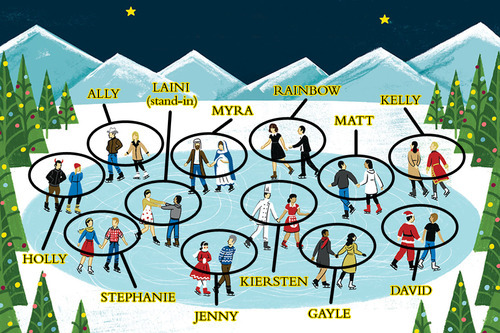
[caption id="" align="aligncenter" width="500"] I was trying really hard to match the skaters on the covers with the romantic pairings in each story, but damn if Laini Taylor's god, Wisha, didn't mess up the uniformity of the figures. Credit goes to another source » click on pic to go to there.[/caption]
Sunday, October 25, 2015

Carry On » Review

Carry On is a strange novel, with a strange, nesting doll-like genesis.  First, there was a little series called Harry Potter and Rainbow Rowell, a writer, wrote Harry Potter fanfiction online.  Then Rowell published an original novel called Fangirl, where a character, Cath, writes fanfiction about a series called Simon Snow, which Rowell bases off of Harry Potter.  Now, Rainbow Rowell has published the book that Cath the character was writing as fanfiction — and both are titled Carry On. Got that?

Carry On is tied so closely to Harry Potter, it can come across as a spoof at times.  There are jokes that I think poke fun at Rowling's masterpiece a little, such as Voldemort's propensity to attack Harry constantly at Hogwarts — purportedly the safest place for Harry to be.  In Carry On, the Mage, our Dumbledore-like character, tells Simon Snow that he must leave Watford School of Magicks immediately because the Insidious Humdrum just won't stop attacking Simon there.  I got a good laugh in at that.

But aside from the jokes, Carry On is mostly a loving homage to both Harry Potter and the the once thriving culture of Harry Potter fanfiction.  While reading Carry On, I felt enormous nostalgia both for Harry Potter and for one of my favorite pieces of fanfiction, The Shoebox Project.  

[caption id="" align="aligncenter" width="602"] The Shoebox Project's Moony, Wormtail, Padfoot, and Prongs.[/caption]
The Shoebox Project was a multimedia effort by two college students, one a writer and the other an artist, who shared the passionate belief of many that Rowling's characters, Remus Lupin and Sirius Black, were so, so gay for each other.  The Shoebox Project was highly sophisticated, hilarious, and moving.  I'm not entirely sure if Rowell is familiar with The Shoebox Project, but I kind of hope she is.  It so perfectly encapsulates what Carry On represents — the brainchild of a nascent writer, made with equal measures of talent and passion, that can never see the mainstream of literature, but is nonetheless followed by many thousands of fans.

Apart from its ties to Harry Potter, Carry On stands on its own feet as a powerful and well-written story.  For instance, Rowell writes characters that are clear translations of Rowling's famous characters, but nonetheless emerge as distinct and fully dimensional characters in their own right.  A great example is Penelope Bunce, our Hermione Granger character.  At the beginning of the story, I was only making comparisons between Penelope and Hermione.  As the story went on, however, I stopped comparing and contrasting entirely.  Penelope Bunce was her own, wonderful and clear-cut character.

As for the romance, it was hot without being explicit.  I loved Simon and Baz together — their intense love/hate obsession and their never knowing if they want to smack or smooch each other. There are not tons of mainstream YA books out there with gay romance, but I can see the tide turning soon. Carry On is a great example of how gay romance can bust out of its niche corner and be appreciated by all.

One thing I didn't like about Carry On was the pacing.  Our exposition was enormous. It took a long, long time for the gears to get turning.  And then, the plot ramped up to a fever pitch.  One revelation was coming after the other, the pages of the book were dwindling, and I just wanted to yell, stop, stop, STOP! Slow down! Instead of a proper triangle, the plot looked like a blip on a heart monitor.

Then there were some inconsistencies with the language.  Rowell did a good job at incorporating British slang, especially in a manner than reads like American fanfiction — jumpers, trackies, boaters, etc. What better example than this quote...
"Agatha, is everything, you know, tickety-boo with Simon?"

There were some places though, where the continuity of language lapsed. Baz being described as "smart" instead of "clever" was a glaring oops.  And then, in the beginning portion of the book, we see "magic" be spelled "magick."  However, later in the book, we revert to the popularized spelling.
"Thank magic! I was worried you'd never speak again."

This isn't a big deal, just something I noticed. Overall, I loved Carry On.  I can't recommend it enough for both fans of J. K. Rowling (which is pretty much everyone) and for fans of Rainbow Rowell.

Bravo, Rowell. Carry on writing, and I will carry on reading.

fangtastic FED-THE-NERD magical MALE


Thursday, October 22, 2015

The Golden Compass » Review


When I was a kid, I was homeschooled, and ran with a very religious crowd. Lutherans, Methodists, Mennonites, Baptists, Southern Baptists... All of my friends had different belief systems, which had subtle differences despite being all 'Christian.' My family, however, was Catholic, and we were a minority in the universally Christian homeschooling community. On the kids' part, we ignored our families' differences when we got together to learn or play. Sparks flew amongst the parents though, and the kids picked up on it. From my mother, me and my siblings learned words like 'Heretic', 'Protestant,' 'Anti-Catholic,' 'Sola Scriptura' and 'Scott Hahn.' A climate of bias against, and downright hatred towards, other Christian religions was the norm of my youth.

In high school, I attended a Protestant cottage school. Okay, I guess it was Southern Baptist technically, but wow the principal loathed Catholics. (This woman was also cruelty incarnate.) She knew my family and I were Catholic and would glare at me when ranting about the extravagances of the Vatican and the morally corrupt popes like I, personally, spoke for the Magisterium. She loved Pullman's His Dark Materials. Loved it with a special kind of passion. Why? Mostly because, besides writing really bomb books, Pullman lobs those bombs at Catholicism.

Pullman's main antagonistic force in his series is the "Authority." This oligarchical organization rules through the power religious belief and wealth, and has enough power and sway to influence world politics. Sound familiar??? In book one of the trilogy, The Golden Compass, we see the Authority give power to an off-shoot organization, which, in turn, kidnaps and mutilates the souls of children.

This is subtle stuff for kids, but a glaringly obvious motive to an adult reader. Now, I don't have a problem with Pullman putting a controversial message into a children's books. Virtually every children's book has a motive, some more intense than others. Furthermore, speaking as a (non-practicing) Catholic, I understand that nothing,nothing is above criticism. To get all worked up over someone else's questioning of your beliefs is the mark of extremism.

I love Pullman's writing. It's classic, lyrical, and vastly imaginative. I also like his powerful and gutsy message. Unfortunately, I will always associate this amazing book with one of the pettiest, most mean-spirited adults I've ever encountered...

But it all works out though. Because all I have to do is imagine my former teacher's head on top of Mrs. Coulter's wretched monkey daemon, and everything is perfect.

Monday, August 3, 2015

The Bone Season » Review

What an odd book! When trying to decide on a rating for The Bone Season, I was waffling between three and four stars. My reasoning for three stars was that, while this book is a fantasy of sorts, it was also unrelentingly weird, and I never really felt like I believed it all. What settled me on four stars, however, is the feeling that a lower rating would be doing the book a disservice, because The Bone Season really is an accomplishment.

I'm not even going to try to explain the plot of The Bone Season. Just know that it involves special powers, an oppressive and discriminatory government, underground crime syndicates, a powerful, humanoid species, and a prison camp/city. It's all slightly baffling, which is, in my opinion, the main weakness of the novel. It was so much to take in. Granted, I'm not sure how the author could have presented her world to us in any other way. All I can say is, I frequently found it overwhelming.

Now for the praise. The creative bravery of Samantha Shannon is something to be applauded. Despite the fact that the world ofThe Bone Season did my head in at times, it was also nice to read something so different from what's usually presented in urban fantasy genre. In fact, I hesitate to call this series true urban fantasy since that genre has become so distinct — read trope ridden — of late. The quality of writing that we see in The Bone Season was also at a higher level than what we typically see in urban fantasy of late. There were slip ups throughout the novel, but for the most part, I was impressed by the solid prose.

Our main character, Paige, is compelling as well. She's 19 during the events of the book, but comes across as much older. She's a quiet, self-possessed young woman, although she's still trying to find herself. Shannon also strikes a great balance between making Paige be special and stand out from the crowd, without turning the character into a reprehensibly superior life form.

Speaking of superior life forms, there is the Warden, who is the second most prominent character in The Bone Season. For him, I really think we need more books to develop him further. He's depicted, throughout the novel, as both a cold, empty shell and as someone with unusual motives that go against the tide of his species. He was a little all over the place, but he was, nonetheless, a commanding presence. I do look forward to see where Shannon takes him during her 7-book series arc.

All in all, there were plenty of bones to pick with this novel, but I couldn't help being impressed despite it all. I'm truly looking forward to following this immense, new series.

Wednesday, July 29, 2015

Illuminae | Review

It's been a few weeks since I closed the cover on Illuminae and I'm rethinking my initial rating of four stars.  I might be a hardass and lower it.  As I've written this review, I've gotten crankier and crankier about certain aspects, although I do have to be fair — this book grabbed my attention from the get-go, and it wasn't until late in the book that I started critiquing its faults.  Let's get down to it.

The novel is narrated through documents and messages, a type of updated epistolary style.  At first I thought that this would cramp the pacing, and it did to an extent, but not nearly as much as I anticipated.  For having all of its action be related as past events, Kristoff and Kaufman did an amazing job at making the the narrative seem like the present.

Our novel starts off with a cover letter for a compilation of documents.  The letter tells its recipient that the documents will relate the story of a catastrophic event on an illegal mining colony (in outer space).  We start off with two teenage survivors of the catastrophe being interviewed (our protagonists).

Before the catastrophe, Kady was a spunky, punky young lady with aspirations of college and traveling the universe.  Ezra was a talented G-ball jock with a close bond with his miner dad.  The two kids used to date.  Except, they messily broke up hours before the catastrophe occurred.  They both made it off the colony, thanks to Kady's badassery, but are on separate rescue vessels. Most of the novel follows their independent activities on different ships.  Ezra is drafted into the military as a pilot.  Kady is taken under the wing of an accomplished computer hacker.

I don't want to get into the plot further, because of spoilers, but there is a lot going on in Illuminae.  There's a pursuit across space, a deadly contagion, malfunctioning artificial intelligence, an evil corporation, and more!  To be honest, it was too much at times. One or two plot points could have been excluded and the story would have been much more streamlined.

Another thing that could have been improved was the style of narration that took up most of the climax. [spoiler]That of AIDEN, the Artificial Intelligence.[/spoiler] In my opinion, it was the least dynamic narrative style, and made the finale of the book annoying to read.  It was like reading high school poetry. Blah. I can't emphasize enough how much I disliked [spoiler]AIDEN.[/spoiler]  Speaking of high school, I hated the texting abbreviations and :P faces that littered the book.  Just personal preference.

One MORE thing.  I couldn't help but notice the extreme similarities between Illuminae and Kaufman's Starbound collaboration with Megan Spooner.  In fact, they are ridiculously alike. Now, writing similar works isn't exactly a sin, but Kaufman is risking becoming a one-note author, which isn't exactly good.  It definitely made me wonder, though, what traces of Jay Kristoff were in Illuminae?  Did he serve to make the male lead more authentic?  Is he responsible for AIDEN? I'm curious, because it's hard to tell.

Now that I've sufficiently ragged on Illuminae, let me spend some time praising it.  The book was good.  Period.  There's a lot of bad YA out there and Illuminae floats to the top without breaking a sweat. I was sucked in the the story immediately and read the book in one sitting. I enjoyed myself.  That is not to say, however, that there's no room for improvement.  I think the novel could have benefited from adding dimension to EVIL Corps, or whatever it's name is, having the characters be fleshed out further, shaving off plot bulk, and more.

All in all, I can see Illuminae being a popular book, but I doubt it'll be a breakthrough hit.

Tuesday, July 28, 2015

The Midnight Thief | Review

The only reason this little fantasy novel came to my attention is because its sequel was on a list for August 2015 releases.  Thank Jesus that I don't have long to wait to read the second book, because I am officially a fan of the series.

The Midnight Thief features thieves and assassins in a fantasy setting — a dynamite combination.  Our thief is Kyra, a young lady who pays the rent by taking on burgling jobs.  She's has a bit of a Robin Hood mentality, however.  She only steals from the citizens of her city, Forge, who can afford it.  Trouble starts, however, when Kyra's impressive talents catch the attention of James, the young and ruthless leader of Forge's assassin's guild.

Now think.  This is a YA fantasy.  Kyra is a young woman.  James is a young man.  All reason and genre precedents lead to there being a romance between the two.  And it sort of happens.  Sort of.  But more than that, there is incredible tension between the two.  I was staggered by what went down between these characters.  I can't say anything more, except that I am extremely interested to see where Blackburne is going to take the relationship between the two going forward.

Somewhat less interesting is our second narrator, Tristam, who is a soldier for Forge.  He has been stationed out beyond the city walls, attempting to protect the suburbs, if you will, from raiding parties of humanoid monsters that ride gigantic cats.  Yes, you read that right.  It's a little weird, but I can forgive the oddity.  Through Tristam, we get the perspective of the side of the political opposition to the assassin's guild and James.  Unfortunately, or perhaps not (???), there may be a love triangle a-brewing amongst Kyra, James, and Tristam.  All I can say is, if Blackburne decides to develop that gist, then I have no idea how things will unfold.  I have a favorite, isallI'msayin'.

I'm almost ashamed to admit... but I'm solidly Team James.  I KNOW! He's so violent and, if not evil, then certainly bad.  He does bad, bad things in The Midnight Thief and I would understand if his status as a love interest is completely compromised.  I can't help, however, but hold out hope for his redemption.  He's an enthralling character.  As Kyra notes:
There was something about James—his intensity of purpose and strength of personality—that could inspire a woman’s loyalty despite the cost.

I'm a fan. Going forward, I hope that James does not become the story's villain outright.  He is given nice dimension in The Midnight Thief, but the ending sees ol' Jimmy on very uncertain grounds.  Basically, I'm dying to see what happens next.

As for complaints, I will say that the pace at the beginning may have been too breakneck.  It was nice to have matters develop so quickly, but it also seemed a little slapdash, having scenes tie up so fast.  Likewise, it might have been nice to have some more world-building happen in beginning so we get a better idea of the setting our characters are operating in.  Overall, it's not bad when your main complaint is wanting moar!

Naturally, I will be reading book two, Daughter of Dusk, the day it comes out.  Stay tuned for my reaction to the second installment in this promising, new series!


The Falconer | Review

Let me start this review with a small rant about steampunk.

Steampunk, or mechanical fantasy as I call it, is a genre of fiction featuring a historical setting with advanced, often whimsical, technology.  It is often set in the Victorian period, although there are exceptions.  Dirigibles, automatons, spider-like vehicles, and weapons masquerading as ladies' accessories are popular pieces of steampunk machinery.

I DO NOT LIKE IT!

I dislike how steampunk machinery makes no scientific sense whatsoever.  I also dislike how steampunk books are often choked with genre cliches and tropes.

That being said, I can tolerate it in small doses.  My favorite series of all time, Lindsay Buroker's The Emperor's Edge, has steampunk elements to it.  However, for the most part, the technology in Buroker's series make sense, and the characters are often slaving over hot boilers or wrangling awkward machinery gone awry.  I like that Buroker's machines are bulky and malfunctioning and hinder the heroes as often as they help them.

On the other hand, Elizabeth May's The Falconer has the kind of steampunk technology that I'm not overly fond of — mechanical hands that shoot out to pour tea and fold bustles.  There are implausible helicopters ornithopters and and little ornate devices that hold tremendous power.  Um, what kind of power and how does the device harness it?  Nevermind that! Tremendous power!!
I connect the star and the remaining knife. Power flows from the objects as they melt together to form the larger star. The metal is smooth in my palm again.

See what I mean?  It's nonsense, I tell you!

As for the rest of the book, it's good.  It's a fun read, with kick-ass heroine and lots of action and antics.  The Falconer follows a young Victorian lady of Edinburgh, Aileana Kameron, whose mother was brutally murdered by a faery.  In the days after her mother's death, Aileana learned that her country has a bit of a faery infestation and humans are being slaughtered because of it.  Shortly after, she met her... unique... tutor, Kiaran McKay, who instructs her in all things murderous and violent.  With his help she goes on a supernatural killing spree.  Her life of wreaking revenge is upended, however, when she learns that the faeries below ground,  imprisoned in their kingdom, are very close to breaking out.

My favorite part of the book, funnily enough, was a character called Derrick.  He plays the comical sidekick, which is usually a part that I care little for.  But Derrick was truly hilarious.  He's a pixie, a male Tinkerbell, and lives in Aileana's closet, mending her gowns for honey, which intoxicates him.  His scenes caused me to laugh quite often.  More than that, he also served to make the fae folk more accessible.  Athough Derrick doesn't kill humans like his larger kinfolk, he is still an uncanny creature.  I liked how May made the villains slightly more sympathetic by giving them a spectrum of behavior that we got to witness.

However, there were issues with the book besides the steampunk.  I found myself arguing with Aileana's logic and the behavior of other characters quite a bit.  The writing also seemed to be... manipulative, unkind, coy?  I felt strung along, as a reader, having things withheld that didn't have to be.  Did the romance really have to unfold that way?  It was strung out for so long that when something did happen it felt too little too late.  And the cliffhanger.  By god.  What a disservice to readers.

All in all, I give The Falconer three stars.  It had good elements and frustrations in equal measure.  However, I will surely be picking up the sequel, which comes out this November.


Tuesday, June 30, 2015

Magonia Review

Since becoming a blogger I've become a different reader.  Before I wrote book reviews, I wouldn't bother finishing a book that wasn't working for me.  Now, I make my best effort to read books in their entirety, because I can write more informed reviews that way.  Still, I was only able to get through about two thirds of Magonia before skipping ahead to the ending and calling it a day.

Magonia is a Narnia-esque fantasy — a girl living in the normal world discovers a magical one, just "through the wardrobe," as it were.  Aza, the girl in question, has always been sickly, unable to breathe air effectively, for some mysterious reason.  Her doctors say she's quickly running out of time.  But, just at a fatal moment, Aza is whisked away to Magonia, a land of bird-like creatures and airships in the sky. Able to breathe the thin air, Aza comes into her own strengths for the first time, but must question the intentions of her new Magonian family. What do they want with her and are they being entirely forthright? Meanwhile, back on the ground, Aza's best friend, Jason, is determined to find her...

I have a lot of problems with Magonia.  One of my main issues is that the book is stretched too thin.  Headley wrote a stand-alone contemporary/fantasy — with only 320 pages!!  On top of that, the novel spends a good amount of time in exposition mode at its beginning.  I think it was the author's intention to build up her characters and raise the emotional stakes of her story by fleshing out Aza's existing relationships before she's taken away to Magonia. It was a good idea, but I think the book would have been better served by jumping into action a little quicker.  Because the beginning lagged, Headley had to start her fantasy world-building late in the game, which hurt the pace of the story.

On top of that, we were pulled away from Magonia over and over again by the chapters focusing on Jason's — largely internal — activities.  He was a thin character, slavishly devoted to Aza.  It bothers me when characters can't stand on their own, and Jason entire purpose throughout the novel was to worship Aza... who was over-worshiped. Her funeral scene left me alternatively sniggering and gaping.  A moment that was supposed to move me, instead gave me the biggest laugh in the book! [spoiler]When Jason, who is wearing an alligator suit, with the words "Aza Ray was here" painted on the head, drives to the burial honking morse code messages to Aza... only not real morse code because he doesn't want anyone to know what he's saying. [/spoiler] Truly, the histrionics in this book turned me off.  The emotion was always ramped up to ten, but because I was not invested, everything came across as clownish.

In case it hasn't come across clearly yet, I do not recommend this book.  A good alternative would be The Blue Sword by Robin McKinley.


Saturday, February 7, 2015

Half a King Review

Truth is, I had to battle with myself to get through Half a King.  Some of my most respected reviewers gave this book high praise, but there were long stretches during my reading where I was not feeling it.  However, I'd been seeing absolute raves over the second book in the Shattered Sea series — Half a World.  I resolved to work through Half a King, because forgoing its sequel seemed foolhardy.  As it turns out, Half a World was, indeed, so worth it.  I gobbled the book up and already have an itch to re-read it.  I'll get to that review in a bit.  For now, I'm going to parse out the strengths and weaknesses of Half a King.

The book has a single narrator — Yarvi, the younger son of the king of Gettland. Yarvi has a nasty attitude, which stems largely from his insecurities over his badly deformed left hand.  He's training to be a minister, a sort of jack-of-all-trades advisor to royalty, but the murder of his father and older brother forces him onto the throne.

At this point, I would have expected Yarvi to stumble through his first months of kinghood, making terrible blunders and chafing under his newfound responsibilities, but gradually getting his legs under him, and slowly winning the respect and admiration of his guard, his ministers, and his people, ultimately becoming a triumphant, if unorthodox king.

The book... does not go in this direction.  That is not to say that Half a King defies all well-worn plot lines.  But it does have an unexpected twist at the onset of the narrative that sends the book spinning into a more unexpected direction.  I won't get into the details, because spoilers!  But we do get to meet a great cast of characters and experience a number of diverse settings.

My main complaint with Half a King has to do with my dislike of our main character, Yarvi.  I've read enough reviews of the book to know that many readers disagree with me.  I totally understand where they're coming from.  I typically love a good underdog hero as well.  Yarvi, however, got on my nerves.  Abercrombie is fond of dirty realism, and lingers over Yarvi's human weaknesses — Yarvi shirks, whimpers, whines, and cries aplenty.  Abercrombie toes the line between making Yarvi realistic and making him a hero readers can get behind.  It's a thin edge, and I fell on the side of disliking the little bastard for his failures.

Fortunately, there were enough good elements in Half a King to distract me from my distaste for the protagonist.  The supporting cast was great.  Abercrombie, although a man, can write some seriously compelling female characters. (Thank you, Joe Abercrombie!)  There were great heroes and villains, as well, and even more in-between characters.  Near the end of the book, there is a totally unexpected and thrilling twist.  It was so much fun to read; my mouth hung open in delighted shock for a good while.

All in all, I can't see myself re-visiting Half a King, but I'm so glad I read it because of its sequel.  Half a World rests on all the world-building and plot set-up of its predecessor and far surpasses Half a King.  I can honestly say that I can't wait for Abercrombie's next installment.  Count me hooked.

Monday, December 8, 2014

This Shattered World Review

TSW tour banner final


Two words —  space romance. Convinced? Okay, I'll work a little harder.

This Shattered World is the second installment in Amie Kaufman and Meagan Spooner's co-written trilogy, Starbound.  The first book, These Broken Stars, is known for three main things, I feel: the gorgeous dress on its cover, its compelling hook, and the oh-no-they-did-not-just-go-there climax.

This Shattered World has fewer pretty cover-outfits, a less juicy hook (in my opinion), but wow, does it ever deliver on the oh-no-they-did-not-just-go-there. While I was reading, I had to put the book down for a few moments and then look back, because I was so sure I'd read a certain moment wrong.  But, no.  Kaufman and Spoon did indeed go there. 

In fact, This Shattered World is full of surprises.  For one, compared to These Broken Stars, the setting is much more hostile. What could be more hostile than a desert planet, you ask?  Well, the events of This Shattered World take place on a planet called Avon, which is lagging far behind its terraforming schedule.  It's a swamp planet — an expanse of sludge.  It swarms with insurgents.  There is a perpetual, gloomy cloud cover, which obscures the glory of the heavens and renders satellites and other technologies useless. However, these harsh conditions do not stop the people of Avon from fighting fiercely for their planet's rights, which are suppressed due to their halted development.

Our hero and heroine are on opposing sides of the conflict...

Flynn Cormac, a rebel, harbors pacifist ideals, and is trying desperately to staunch the violence that wreaks his home.  Jubilee Chase is an infamous captain in the military presence that is attempting to stifle the Avon rebellion.  The two meet in the very first sentence of the very first chapter.  It's an explosive exposition.  I was not expecting the book to take off so quickly, but wow, was I impressed by the opening.

Since it's said in the synopsis, I think it's okay to mention: Flynn abducts Jubilee and brings her to the rebel base!  (Though not without a dirty knock-down fight. A cocktail skewer is involved.) From there, the plot unfolds.  It was fairly unpredictable.  There were several moments where I thought, surely this is the climactic moment! But no, my e-reader told me over and over again that there was still a long way to go.  It was as if Kaufman and Spooner kept trying to top themselves with what hairy situations they could throw their characters into.  By the time I got to the true climax, I was almost fatigued. Our protagonists had certainly been put through the ringer. Thank goodness for sci-fi health care!

Speaking of our protagonists, I think the characters will please readers.  Jubilee Chase is a bad-ass heroine, who takes a lot of initiative.  It's a tad implausible that a such a young girl would achieve so much so quickly, but hey, this is YA fiction. Just believe! Flynn's character turned out to be a good counterbalance to Lee — more thoughtful and restrained, while still being capable.  I appreciated how both characters were driven by strong senses of integrity, although they acted on their beliefs in different ways. (Side note: Gradually, it's revealed that the people of Avon are descended from the Irish.  My appreciation of Flynn's character grew exponentially once my inner voice started to read his lines with a brogue.) Also, a plus, we get to see a good deal of Tarver and Lilac, from These Broken Stars. They pop up in an unexpected manner that's sure to delight fans of book one.

And here's something that might surprise you. Unlike These Broken Stars, This Shattered World focuses less on romance.  That is to say, romance was still a large presence in the book, but equal time, if not more, was spent on the troubles on Avon, the events of the rebellion, and the overarching plot-line of the trilogy.  This was both a plus and a minus, in my opinion.  A plus because it gave This Shattered World some meat on its bones, and a minus because who doesn't love a good swoon?  It's my belief that This Shattered World did not have the most compelling romance, but I've read enough reviews of the book to believe I might be in the minority on this one.

Overall, This Shattered World was a great follow-up to These Broken Stars.   There was a fantastic, atmospheric setting, taut conflict, and bold decisions were made.  Kaufman and Spooner continued to show us how love can flourish in the most hostile of environments.  But can love conquer something as powerful and evil as  La Roux Industries?? I am so eager to see how Kaufman and Spooner will wrap up this trilogy!


Sunday, December 7, 2014

Code Name Verity Review

Giving this book 3 stars makes me feel like I have no class.  Certainly, this book deserves a higher rating.  But although I appreciated the novel for its meticulous research, daring plot, and unusual narration, it just did not capture my heart.

I'm heartless along with having no class!

The story opens bleakly, with our narrator captured by the Gestapo. We are reading her written "confession" as it were.  She spins a tale of two young women — one is from Manchester, the other is a Scottish noble.  Maddie and Queenie meet during the war effort in 1936, on an air base. The two quickly become friends, but are separated as they take different paths.  Then, they are thrown together again unexpectedly, as both are needed for a top secret mission in France.

I'm not entirely sure why this book was marketed as YA.  Although the ages of these women are never discussed, they're certainly not teenagers.  The only reason I can think of is that the book has a less mature tone.  This sounds bad, I know.  What I mean is, I found the premise to be slightly implausible.  Certainly women took on a more significant role in the war effort during World War II, but I found the story of Maddie and Queenie to be such that is only possible in fiction.  It's the kind of wish fulfillment frequently found in YA literature.

One thing is undeniable, however — the book is incredibly well researched.  So much so that there's a bibliography at the end of the book.  The detail is superb; the voice is solidly of the period. It was extremely impressive.  That being said, I did think that the language was at times overly clogged with this period detail. This made my progress through Code Name Verity somewhat labored.

Another aspect that disappointed me — I can't seem to stop myself — was the friendship between Maddie and Queenie.  I guess I was expecting more chemistry.  But, apart from the fantastic early stage of their relationship, the reader doesn't get to experience the two together so much.  This was a bit of a letdown, since I was looking forward to reading about a solid friendship.

All of this is to say that I expected more from the book than I experienced.  Somehow, though, I feel more disappointed in myself than in the book.